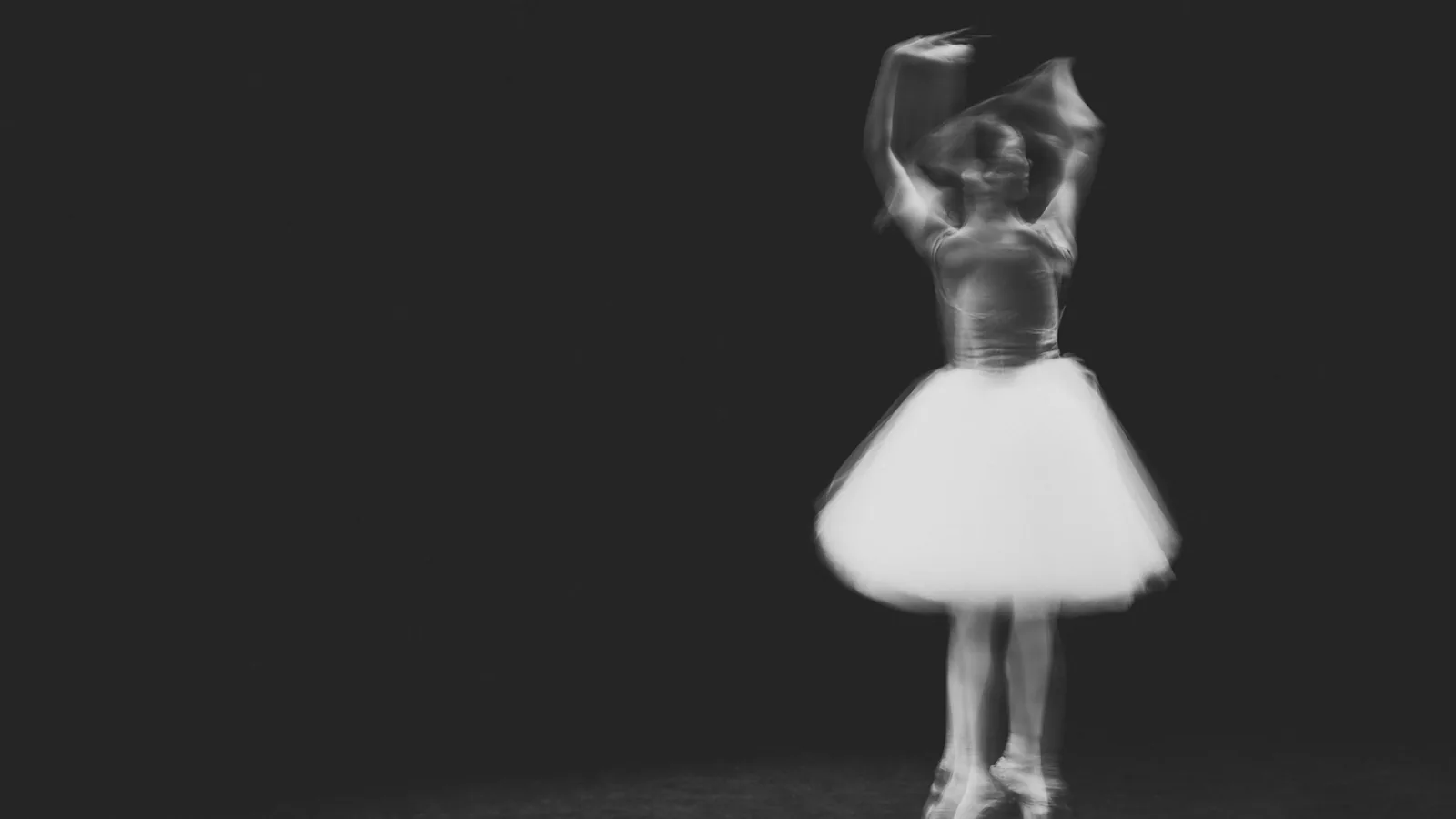
How you enter and finish a turn shapes its course. The preceding movement creates conditions for the rotation. The turn’s ending then provides the starting point for what follows. Looking at the whole sequence helps make sense of it: a difficulty that becomes visible during the turn may have originated in an earlier part of the movement.
Rotating while moving through the room
Rotating around your own axis and travelling through a room are different tasks. Two ballet turns illustrate this: a pirouette can involve little displacement, whereas a piqué turn includes sideways travel. Biomechanist Antonia Zaferiou uses this distinction in her research. Through contact with the floor, the legs must organise both rotation and movement of the body’s centre of mass. The useful force directions do not automatically coincide. Counting revolutions therefore tells us only part of what a turn demands. Its path is part of the movement, too.
Where angular momentum comes from
In physics, the turning effect of a force is called torque. It depends on the force, its direction and its lever arm relative to a reference point. That is why pushing a door at its handle differs from pushing beside the hinge. External torque acting over time changes angular momentum, the physical quantity describing rotational motion.
Magnitude and timing matter together. A brief strong torque and a weaker torque lasting longer can produce a similar change. One powerful instant therefore cannot tell us everything about the motion that follows.
In dancing, this preparation requires coordination. In a study of nine experienced ballet dancers, generated angular momentum increased from single to double and triple pirouettes. The generation phase did not become significantly longer; the rate at which angular momentum was produced mainly increased. The arms and upper trunk contributed. These were successful trials from a prescribed starting position, which does not establish a general instruction to use a larger wind-up. The timing is revealing: preparation already reflects the intended turn. More revolutions cannot simply be equated with more preparation time.
Body shape changes the rotation
Speed can change even when angular momentum stays the same. Bringing body parts closer to a shared rotation axis reduces the moment of inertia: mass is distributed less far from that axis. If external torque is negligible, rotational speed then increases. A skater drawing in their arms illustrates this principle.
This simplified model explains a relationship between shape and speed. Rotational energy need not stay constant: drawing the arms inward requires work. It does not decide which arm position suits a dance variation. A more compact shape is not automatically a better one.
Coordination between body segments adds another layer. Visible upper-body rotation cannot be attributed to a single “turning muscle”. A biomechanical analysis of eight ballet dancers examined how hip joint moments contributed to upper-body rotation. Their contributions changed with movement phase and leg position. A joint acts around its own axes, while the resulting effect must also be considered in space. Even a hip joint moment associated with moving the leg sideways can contribute to upper-body rotation. The visible shape reveals only part of the underlying organisation.
Balance keeps moving throughout the turn
A turn that looks steady contains small changes. Researchers tracked pelvis and foot markers in ten female university ballet students performing double and, in some cases, triple pirouettes. Their relative position kept changing. On the preferred side, double turns received better self-ratings while showing more variability during the transition onto one leg. These exploratory observations show movement within an apparently fixed turning position.
Control can therefore include ongoing adjustments within a successful turn. Complete stillness within the body’s posture would be an unsuitable measure of that control.
The moment when rotation ends matters just as much. A comparison of thirteen experienced and thirteen less experienced ballet dancers found differences in the measured postural fluctuations during preparation and again at the finish. The less experienced group was also considerably younger, so experience alone cannot explain the differences. One useful observation remains: watching only the middle of a pirouette overlooks two demanding transitions. Arriving belongs to the turn as much as starting. Completing a counted revolution says little about how controlled that arrival is.
What the gaze contributes to orientation
Rotation also raises the question of where the gaze is directed. In spotting, the head and the rest of the body turn at different times: the gaze initially stays with a reference point and returns to it after the head turns. This creates a different rhythm from rotating all body segments together. In a multi-round survey, dance experts described functions including orientation and rhythm, but differed over the importance of individual features. Spotting serves several purposes; an explanation should specify which purpose matters in the particular turn.
Less dizziness and better balance are separate outcomes. In a 2024 study, 34 trained ballet and contemporary dancers completed, among other conditions, fourteen consecutive active turns with and without spotting. They reported less dizziness afterwards with spotting. However, measured standing stability after these active turns did not improve correspondingly. Gaze coordination can affect the experience of repeated rotation without changing every balance measure in the same way. The study assessed standing after a particular turning sequence; it does not directly establish the best gaze strategy within an improvised partner-dance variation.
The shared continuation belongs to the variation
Brazilian Zouk offers specific teaching approaches to these questions. In his written guidance, Arthur Santos distinguishes spins from travelling turns: turning on the spot and turning while moving along a path. For spotting, he identifies the partner or the direction of travel as possible references. These suggestions connect orientation to the task. They represent one teaching perspective within Brazilian Zouk, rather than a gaze technique binding on every approach. The reference itself changes the spatial priority: the shared position or the direction in which the variation develops.
The Bonus description in Bath Zouk’s teaching library also connects rotation with continuation. In that version, a possible additional half-turn depends on where the leader arrives relative to the follower. The final orientation emerges from the shared situation, as both dancers position themselves for the continuation. Turning changes their relationship in space. Where they finish relative to one another is already part of the variation. Its ending leads directly into their next shared movement.