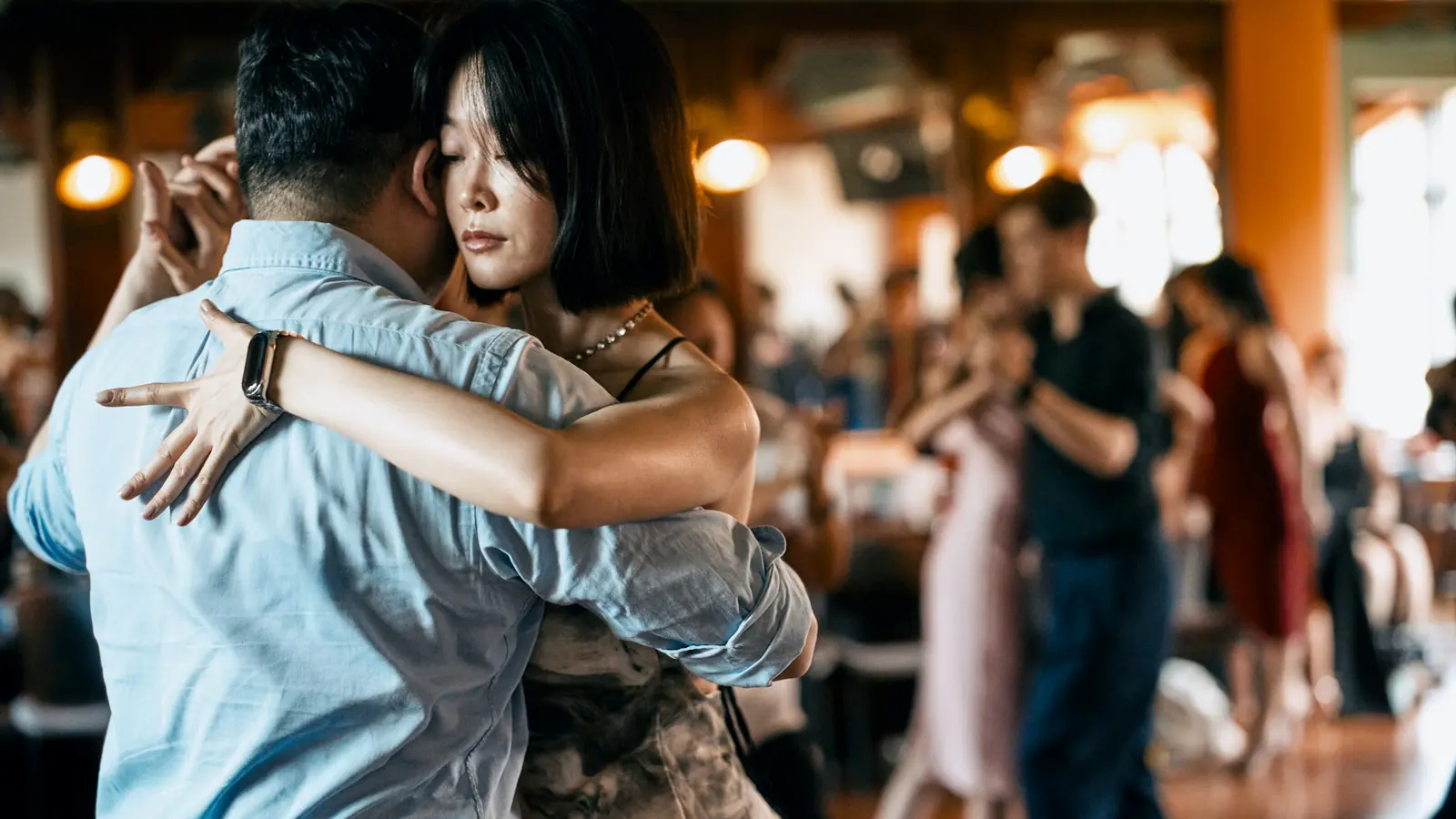
You know the music often played in your local scene, and some of your teachers' explanations have become familiar. Then a festival programme lists a subject you would like to approach from another direction. Or you discover a teaching couple whose response to music makes you curious. An international dance festival can begin with that interest: you bring your existing dancing and meet people whose experiences of it are different.
Part of the appeal lies in having several possibilities close together. Classes, social dancing and conversations can follow one another over a few days. An idea from a workshop stays with you during a song later on; an encounter introduces you to music you have barely heard before. How this develops remains open. Two published Brazilian Zouk programmes from 2026 show how organisers planned to make room for it.
Several teaching approaches make differences visible
Zouk Republic in Porto Alegre announced an interconnected sequence of classes for April 2026. The programme included fundamentals with Wagner and Letícia, awareness of contact with Bruno Arknjo, and embellishments and footwork with Jefferson Dadinho. These subjects already distinguish a movement foundation, contact and expressive choices. The announced concept brought different artists' perspectives together within a shared structure.
The Advanced Techniques Intensive in the additional 2026 Zouk Month programme on Koh Phangan also brought several teaching couples into its planned format. Announced subjects included axis control with Fernando and Olga and musical structure with Gui and Paloma. Technical explanations, progressive exercises and exploration with a partner were intended to complement one another. Different teaching approaches were thus part of the announced concept.
When making your own choices, there is more to discover here than a list of familiar names. A movement subject might become understandable through a precise description, a vivid image or a comparison between two ways of performing it. A familiar detail gains a different context. You can notice which explanation helps something make sense and which does not yet offer you a way in.
Different statements need not immediately become a contest to identify the correct method. They may concern different tasks, movement sizes or stylistic intentions. What matters is the purpose of an explanation and the conditions in which it applies. This allows you to retain your own orientation across several workshops. You listen to different people and later take time to see how you can use their explanations.
You bring your existing dancing with you
You arrive with a particular experience. Perhaps you have danced for a few months; perhaps you teach or already know many festivals. In any case, familiar movements, preferences and unresolved questions are part of your starting point. A festival does not have to transform that experience completely to be interesting for you.
If you are interested in shaping transitions, for example, a workshop on fundamentals may be as relevant as one on more complex variations. Its relationship to your question matters. An advanced-sounding title alone does not tell you whether the content suits your preparation. The Zouk Island Intensive announcement explicitly required strong fundamentals. This described a particular entry requirement, rather than a measure of the value of other offerings.
Familiar material can also become new through another perspective. You recognise a basic variation, but this time pay attention to a different part of the movement. Or you understand more clearly why an explanation that has helped you before is insufficient for a different task. This can expand your understanding without devaluing what you have already learned.
Your interests can therefore have a clear voice when you choose a programme. What would you like to explore more closely: musical interpretation, footwork or coordination with a partner? Such interests are more specific than an intention to take in as much as possible. They also leave room for something you had not previously noticed.
More room for music
Alongside workshops, the 2026 Zouk Island festival programme listed socials with different DJs and dedicated sunset sets. Social dancing thus had several time slots of its own. You can look for this balance when reading a programme.
On the dance floor, the task changes. You listen to a song as a whole and shape what feels appropriate in that moment with your partner. A combination from a workshop may appear. Perhaps only an idea for a transition remains, while the rest of the dance develops in another direction.
Unfamiliar music can give your attention something new to follow. You do not yet know when the voice will return or the arrangement will change. With a familiar song, you may already be anticipating a particular passage. Both can be enjoyable. A festival provides an occasion to explore these preferences and hear what draws other people to a recording.
Time beside the floor can be worthwhile too. You can observe how differently people respond to the same music: through larger or smaller movements, pronounced accents or a quieter progression. Watching does not have to become an assessment. You can simply notice an idea you would like to explore later, or rediscover a song that stays with you.
Dance culture has faces and stories
Zouk Island 2026 also listed “The Joy of Brazilian Culture” with Brenda and William. A session of this kind can draw attention to the contexts surrounding a dance form and make room for conversations about music or personal experience.
Cultural exchange requires attention to particular people. A teacher might talk about their own training or explain which music matters to their work. That is their perspective. One person need not represent a whole country or speak for every expression of a dance. An international gathering can allow different stories to sit alongside one another.
Terms can provide something to talk about too. Zouk Republic's programme used the Portuguese word for fundamentals alongside the English word footwork. When learning, it matters whether the subject is footwork, a complete variation or the organisation of shared contact. You can connect the words being used to what is actually demonstrated. An unfamiliar term gains a specific meaning in this way.
This need not produce a uniform picture of the international dance world. Differences can remain visible: in the music people associate with a dance form, the movements they enjoy shaping or what they value in an encounter. Recognising that variety offers more points of connection than simply asking whether something feels exactly as it does at home.
Encounters need no particular outcome
A shared workshop initially gives you a common activity. You work with the same material and may discover that a task develops differently with different people. At a social, you meet again in another setting. A conversation might follow, another dance together or a brief, friendly exchange that is complete in itself.
International encounters are not automatically effortless. Sometimes words are missing; sometimes expectations differ. Even on a dance floor, wishes and boundaries are not always understandable without language. A simple conversation and an attentive manner can therefore belong alongside the pleasure of a movement that works well together.
Nor do you need to turn a festival into a networking project. An encounter can have value without exchanging contact details or meeting again. Perhaps you remember a comment about a song. Perhaps you see someone again at another event. What develops is something the people involved shape together; a programme can create opportunities for it.
What you bring into your own dancing
After a festival, new ideas will not all become part of your dancing immediately. Some material remains unclear; other things may have interested you more as a spectator. You can take time to distinguish these impressions. Performing a movement yourself, enjoying how it looks on someone else and following its explanation are different experiences.
A specific point of interest can help you continue working. It might be a basic variation whose transition interests you, or a musical idea you want to explore with a familiar song. You return to it under conditions you know. This may make it clearer which part already works for you and which needs further attention.
Perhaps you also discover a teacher whose work you would like to follow for longer. A festival can then begin a more sustained exploration. Encountering several perspectives does not rule out continuity. You can become more familiar with one approach while remaining aware that other artists shape the same dance form differently.
Back in your familiar surroundings, there is still room for an ordinary evening of dancing. Music plays, someone invites you and you begin to dance together. A new idea can appear without determining the entire dance. Or you might suddenly hear a familiar song in another way.