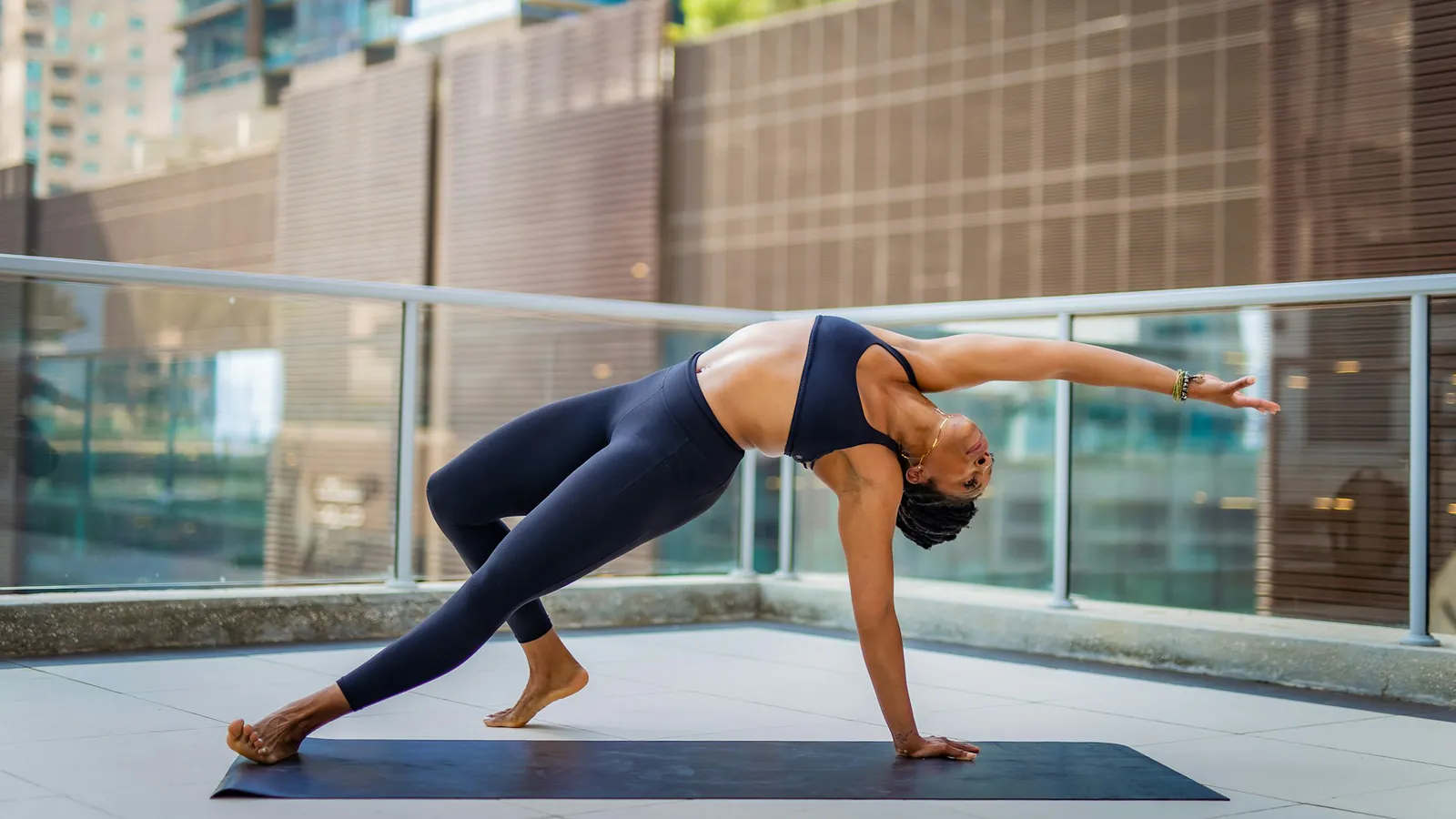
Lifting a leg, turning a foot outwards, rotating the upper body within a figure: even these familiar dance tasks raise very different questions about mobility. Which movement are we discussing? What should move with it, and what should keep its orientation? Flexibility, stability and control can help us describe these questions more precisely. This involves looking at joints, the effects of forces, and the difference between movement at one joint and a complete dance figure.
What is available and what you move yourself
Range of motion describes how far a particular joint or body region can move. In an assessment, active means that the person performs the movement themselves. Passive means that the joint is moved externally. Starting position and stabilisation also belong to the measurement. Here, passive flexibility means the range available with assistance, while active mobility means the range produced by the person. A leg raised externally and one you lift yourself are therefore assessed under different conditions. This distinction describes the execution; by itself, it does not explain why the angles reached might differ.
Control also needs a specified task. Should the foot trace a particular line on the floor? Should the knee remain bent while the leg turns sideways? Or should an established shape remain until an agreed musical cue? These offer different criteria for considering the movement. Only then does “more control” become a useful description. A movement can meet one part of the task and miss another, perhaps reaching the intended place while losing an orientation that was explicitly meant to remain throughout.
Joints and levers change the conditions
A joint is not a connection that can bend in any direction. In joints such as the shoulder and hip, the shape and fit of the joint surfaces influence the movements available. Both are ball-and-socket joints, but the hip socket encloses the joint head more deeply than the shoulder socket does. The capsule and ligaments help hold the joint together and limit movement; muscles and tendons provide additional support. Available range therefore cannot be explained solely by one muscle's flexibility. The anatomy itself combines movement possibilities with guidance and support.
The effect of a force also depends on its relationship to an axis of rotation. Its torque is the force multiplied by the perpendicular distance from its line of action to the axis. The same downward-pulling object produces more torque on a horizontal lever when it is further from the pivot. Changing the lever's orientation can also change that distance. Applied to a limb, its weight alone is therefore insufficient to describe the resulting torque at the joint. The external demand can therefore change along the path without any additional load.
Muscles also act through moment arms that can change with joint position. Murray and colleagues investigated this using two anatomical arm specimens and a computer model. For the biceps, forearm rotation changed its elbow-flexion moment arm alongside changes in elbow position. One moment-arm value inadequately described the full range. Active movement therefore involves the geometry of muscular action as well as muscle force. This explains part of the changing demands along a movement path; the study establishes neither an ideal hand position for dance nor an individual's performance capacity.
A path through space can in turn be distinguished from joint angles. Imagine a simple drawing consisting of a hip point, thigh, lower leg and foot point. Keep the lengths and angles unchanged and shift the whole drawing sideways: the foot point moves sideways too. Nothing has changed at the joints in the drawing. Rotating only the lower leg around the knee point instead changes the angle between the two leg segments. Either can bring the foot to a new place. This is initially just geometry. For a dance description, it shows why “the foot should move further out” leaves open which change within the figure is intended.
Stability belongs to a particular movement
In connected body segments, movement at one joint changes the demands at other joints. Gribble and Ostry studied ten adults performing horizontally supported arm movements. Muscle activity changed even at the almost stationary joint in relation to movement of the neighbouring segment. Its direction also mattered. The findings support anticipatory adjustment to interaction torques. An apparently quiet segment can therefore be actively involved. These were laboratory arm movements, not dance figures.
In dance, stability can be framed as a task: which relationship should remain throughout this passage? In an imagined choreography, the upper body might keep facing one side of the room while the legs change orientation. In the next passage, the upper body is specifically meant to turn with them. The two instructions differ in what should be maintained. In the first, the changed orientation would depart from the task; in the second, it would belong to it. Here, “stable” describes a consistent relationship within the chosen movement. It does not demand that every body part remain unchanged throughout the dance.
Individual starting points deserve a precise description
External hip rotation illustrates how different these starting points can be. It contributes to turnout in ballet. A specialist paper from the dance medicine organisation IADMS describes the orientation of the hip socket and the shape and orientation of the femoral neck as contributing factors. The surrounding soft tissues also play a part. The visible outward position of the feet does not simply equal external rotation at the hip. A shared external target therefore does not automatically mean identical anatomical conditions. This ballet example explains individual differences without prescribing foot placement for Brazilian Zouk or other partner dances.
Numbers also have a specific context. A CDC study recorded ranges of motion in 674 people without known joint pathology. The data distinguish joints, movement directions, age and sex. Its documentation specifies how participants and the body parts examined were positioned and what counted as the movement's endpoint. These conditions belong to the measurement, rather than merely its small print. Comparing two numbers requires knowing whether they describe the same movement under comparable conditions. The published group values are health reference data; they do not provide a required angle for a dance figure.
Greater range and its use in dance
A change in range also has several possible explanations. A systematic analysis of 65 controlled studies of static stretching found indications of reduced tissue stiffness and, after repeated training, increased stretch tolerance. An increase in muscle fascicle length, meaning the length of muscle fibre bundles, was not demonstrated overall. Evidence certainty was low to very low, and participants were predominantly male. Greater measured range therefore does not automatically mean that a muscle has become permanently longer. The measurement alone does not reveal the adaptation mechanism.
Active and passive range can also develop differently. In a small dance study, 35 adolescent female dance students completed a six-week comparison of strength training and two stretching interventions. Passive range improved in all groups. Active-range results favoured the strength group and the group using lower intensity stretching. The researchers examined particular leg movements. Continued dance training, the small sample and similarity between the strength task and movement test limit generalisation. The study makes the distinction between these measurements tangible; it does not assess control during social dancing.
For a shared figure, it is worth stating the intended shape in full. As a thought experiment, two dancers should finish side by side, facing the same direction in the room. The task might include a specified hand connection or allow contact to release along the way. These are different agreements even though the same arrangement is intended at the end. Where connection remains, its continuation belongs to the description. Where it is released, that particular requirement falls away. This identifies which parts of the figure are specified and which remain open, without using one person's body as the measure for both.
A clearly stated dance goal might then be: this figure should work with this orientation and this shared connection. That gives the discussion something specific to address. The question of whether more range is needed can follow, alongside questions about execution within an already familiar movement. Mobility has a place within a concrete action. This allows possibilities and difficulties to be discussed without turning one characteristic into a judgement on the whole dance.