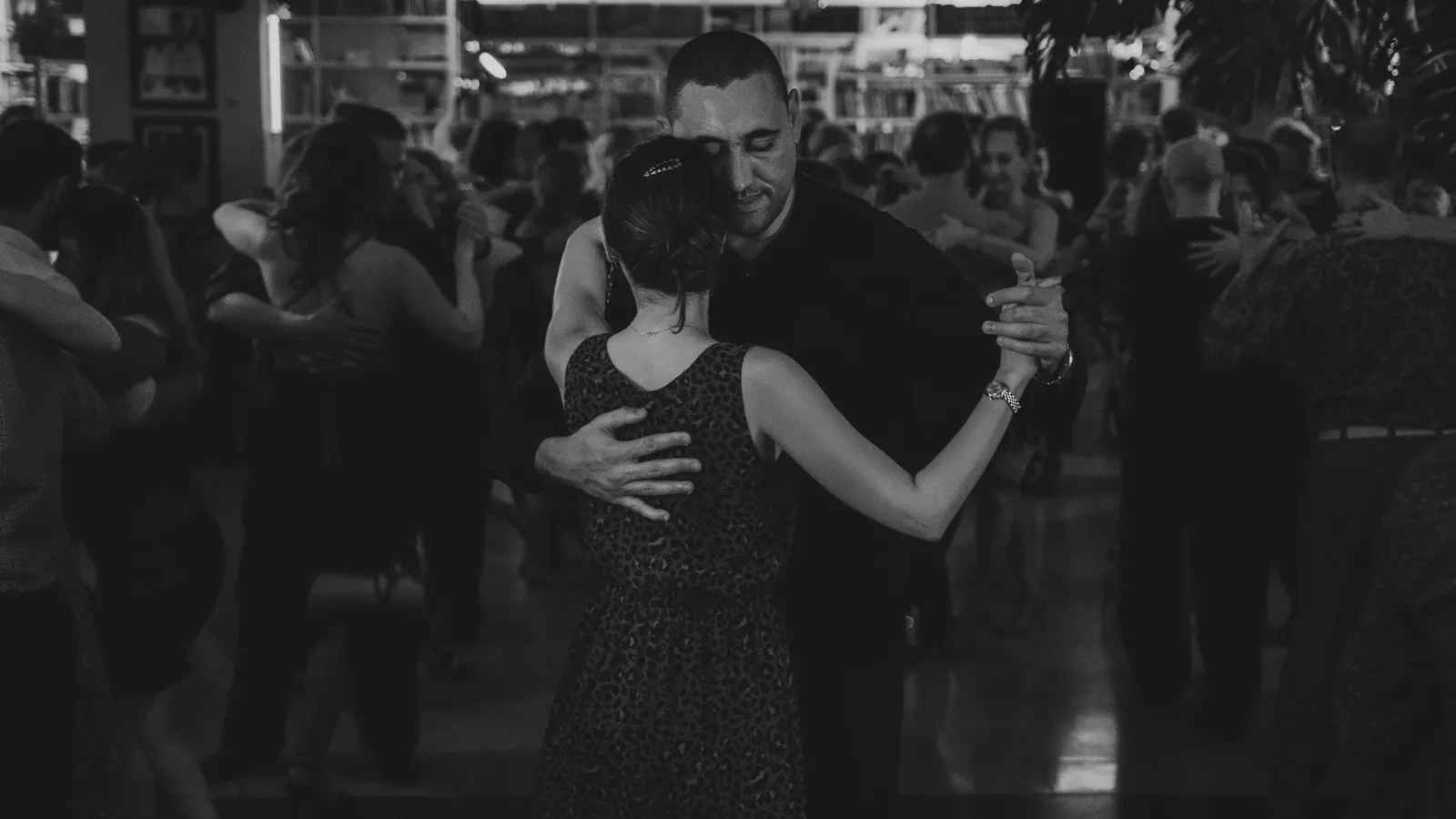
Floorcraft concerns how you share space with other dancers. In his Zouk teaching, Gui Prada describes both navigation and the choice between travelling and staying in place. A familiar variation can change in size and direction to accommodate this. Space becomes part of the dancing task: which execution fits here, now? That decision happens during the dance and also concerns the people around you. A familiar sequence does not need to follow the same pathway every time.
Pathways within the pair and the room
In Brazilian Zouk, you may also encounter the word tracks. District Zouk connects an understanding of these pathways with basics danced on the spot, sideways and along a line in its foundational teaching. Direction changes and playing with tracks are added. This describes how both people organise their paths within a combination. Such a track belongs to the movement being danced. It does not establish how all couples should divide the room. Distinguishing these levels helps place a technical instruction in its context.
The ronda in Argentine tango is an example of a shared spatial arrangement. Phoenix Tango describes dancing counterclockwise and remaining in a chosen lane without overtaking other couples or crossing the floor. This convention concerns how several couples progress together. Someone arriving from another dance style encounters an additional task: their own pathway needs to fit the circulating movement. Such a rule cannot be understood from one pattern alone, nor should it be transferred without checking to every Zouk social.
Entering an already moving floor
Entering the floor is already part of this task. For a crowded ronda, Tangology101 recommends making eye contact with the leader of the couple you intend to enter in front of. The arrangement around the edge matters too: clear entrances and routes behind tables avoid the need to walk across the floor. This distinguishes a visible gap from a coordinated entrance. People already dancing should be able to recognise that someone is joining them. The precise convention belongs to the particular dance event.
Both dance roles notice their surroundings
During the dance, attention remains a shared task. Fine City Swing asks both dance roles to observe their surroundings and look out for each other. Dancers should use available space without pushing other couples out of the way. More crowded conditions call for smaller, more contained movements. This suggests a practical shift in attention: neighbouring movement belongs to the situation alongside one’s partner. A follower can notice an approaching collision and respond. A leader likewise cannot simply rely on other couples to move aside.
Movement selection also needs to fit the surroundings. BraZouky advises against nonvertical head movement on crowded floors. Its festival code also requires respecting the partner’s preferred amount of body contact. Limited space therefore gives no reason to pull someone into a closer embrace without agreement. Both questions need compatible answers: what does the floor allow, and what contact feels comfortable for you? Sometimes this means leaving out a variation. Knowing a movement does not oblige you to perform it under changed spatial conditions.
When a collision happens anyway
After a collision, attention belongs first to the people involved. The swing blog Swungover recommends acknowledging the contact and checking whether everyone is all right. If another couple has to stop because of it, one’s own dancing should also pause to check on them. An apology need not become an immediate argument about fault. If one’s own movement caused the collision, changing that behaviour is part of the response. Establishing what happened first makes it clearer which continuation, if any, would be appropriate.