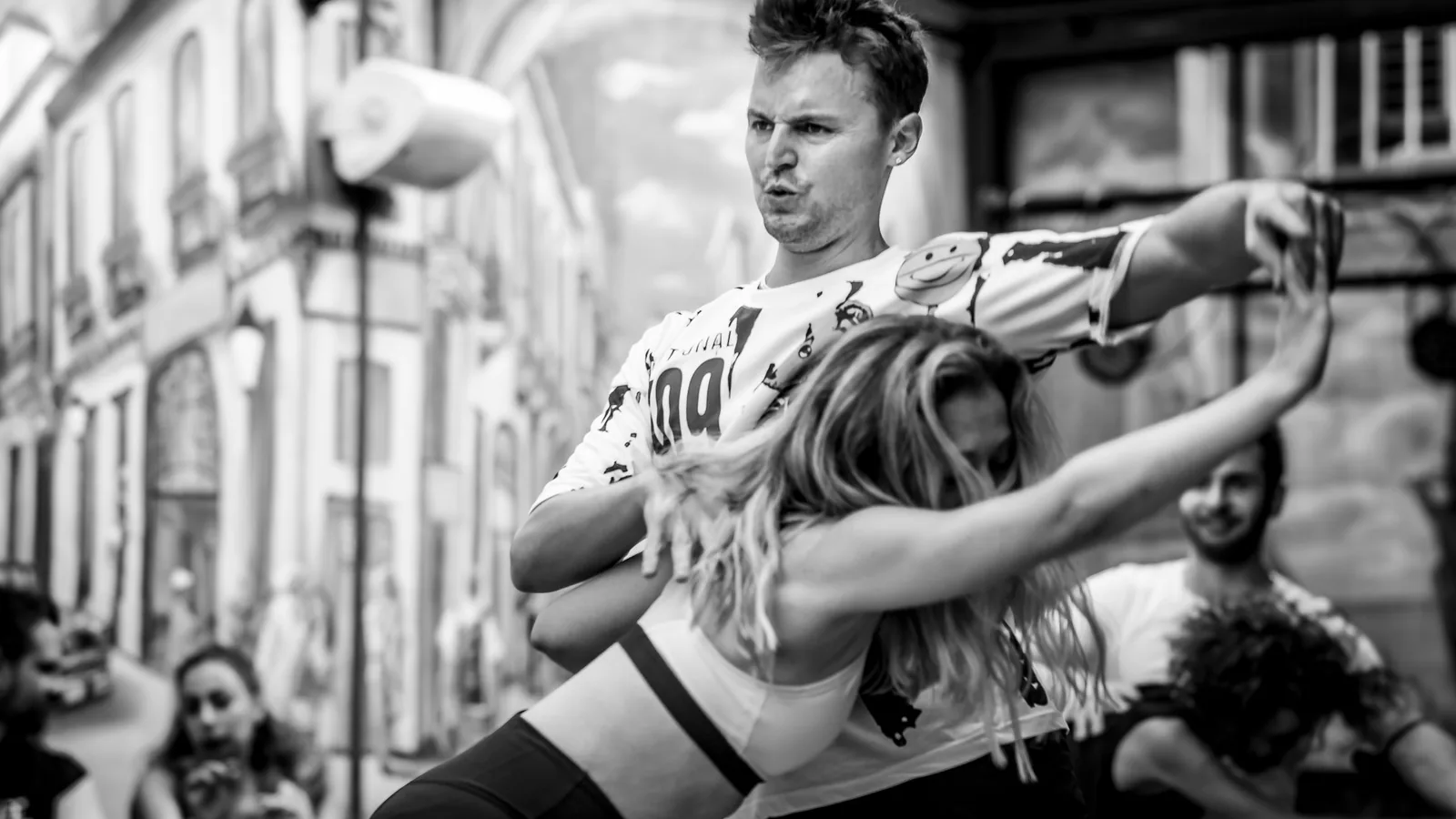
What would you like to experience when leading or following? Perhaps you enjoy shaping a familiar figure to the music. Perhaps you want to be surprised by an unexpected idea. These wishes already suggest different expectations of what each dance role should contribute. They are worth examining: who decides the direction, who shapes the movement, and how much emerges between you? A useful explanation should be able to identify those decisions. The words leader and follower alone tell us relatively little about them.
Proposing a direction and shaping movement
In her teaching model, tango teacher Veronica Toumanova distinguishes the proposed direction from its execution. The leader organises the couple’s path; the follower moves actively and shapes that movement through their own musicality. Their actual movement then requires the leader to adapt. A given figure can therefore still contain decisions. Toumanova is describing her view of tango. The useful question concerns each person’s contribution to movement: proposing a direction and carrying it out as dance are different tasks, both of which can involve creative choices.
Sharna Fabiano places a different emphasis in her account of dance roles: complementary tasks without ranking the people involved. She describes following as attentive, responsible and expressive. This is her teaching perspective, not a survey of every dance community. The distinction nevertheless helps when considering a particular figure: different responsibilities describe how movement is organised. They do not assign greater personal worth to one role. Proposing the next direction therefore need not mean deciding the entire expression of both dancers.
When an idea receives a response
Swing teacher Bobby White describes this exchange from the perspective of a leader who listens. A follower’s variation can inspire an idea, receive a complementary response or change how the dance continues. The follower’s contribution can thereby influence what the couple creates. An interesting moment comes after the variation too: is it noticed, and does anything happen with it? White’s teaching idea directs attention towards that response. A planned sequence remains open to change when a partner’s idea suggests another continuation.
A response need not take the same shape. West Coast Swing Online describes taking up a movement quality: an expansive movement can receive an equally expansive response in a different form. Both people create something related without mirroring each other exactly. The teaching article considers these possibilities for both roles. This broadens the idea of shared expression: dancers can relate through a movement’s quality while their individual shapes differ. It is an idea you can look for without needing a complicated figure.
Bringing your movement style to Brazilian Zouk
In its teaching description, Bath Zouk emphasises the different movement styles of both people. The school uses the term “followfreedom”, among others. It describes personal influences, such as hip-hop or contemporary dance, as possible contributions to shared expression while considering the connection. This is a particular perspective within Brazilian Zouk. It does not give blanket permission to insert any element into every dance. Its question is how your style can meet your partner’s style. Difference becomes something the couple works with.
Becoming aware of your own execution also requires attention during learning. Laura Riva recommends addressing followers explicitly and explaining their part in a movement. A familiar basic figure might provide an opportunity to work on weight transfer or alignment. The follower’s task remains a subject of learning in its own right. Riva’s teaching perspective adds a question about using creative space: what do I perceive, and what do I do myself? Understanding your movement gives you something specific to discuss during shared practice.
Exploring both roles and keeping your preferences
Learning another role takes practice in its own right. In a 2017 Zoukology interview, Hisako Izutsu explained that her focus on leading had left too little time for her own following. She subsequently returned to deliberate practice as a follower. Her account describes a personal allocation of practice time. It establishes neither a general disadvantage of switching roles nor an obligation to learn both. It does raise a practical question: which part of your dancing do you want to develop, and are you actually making room for it?
You can prefer one role and still be curious about the other. Your wishes for a dance evening may also vary: exploring attentively today, enjoying familiar dancing another time. Contributing ideas should not become another performance requirement. Nobody needs to produce a particularly original response in every figure or continually prove how active their role is. If you want to explore something, you can arrange that with a familiar practice partner. A clear wish such as “I’d like to explore my musical expression today” leaves the outcome open while making your interest understandable.