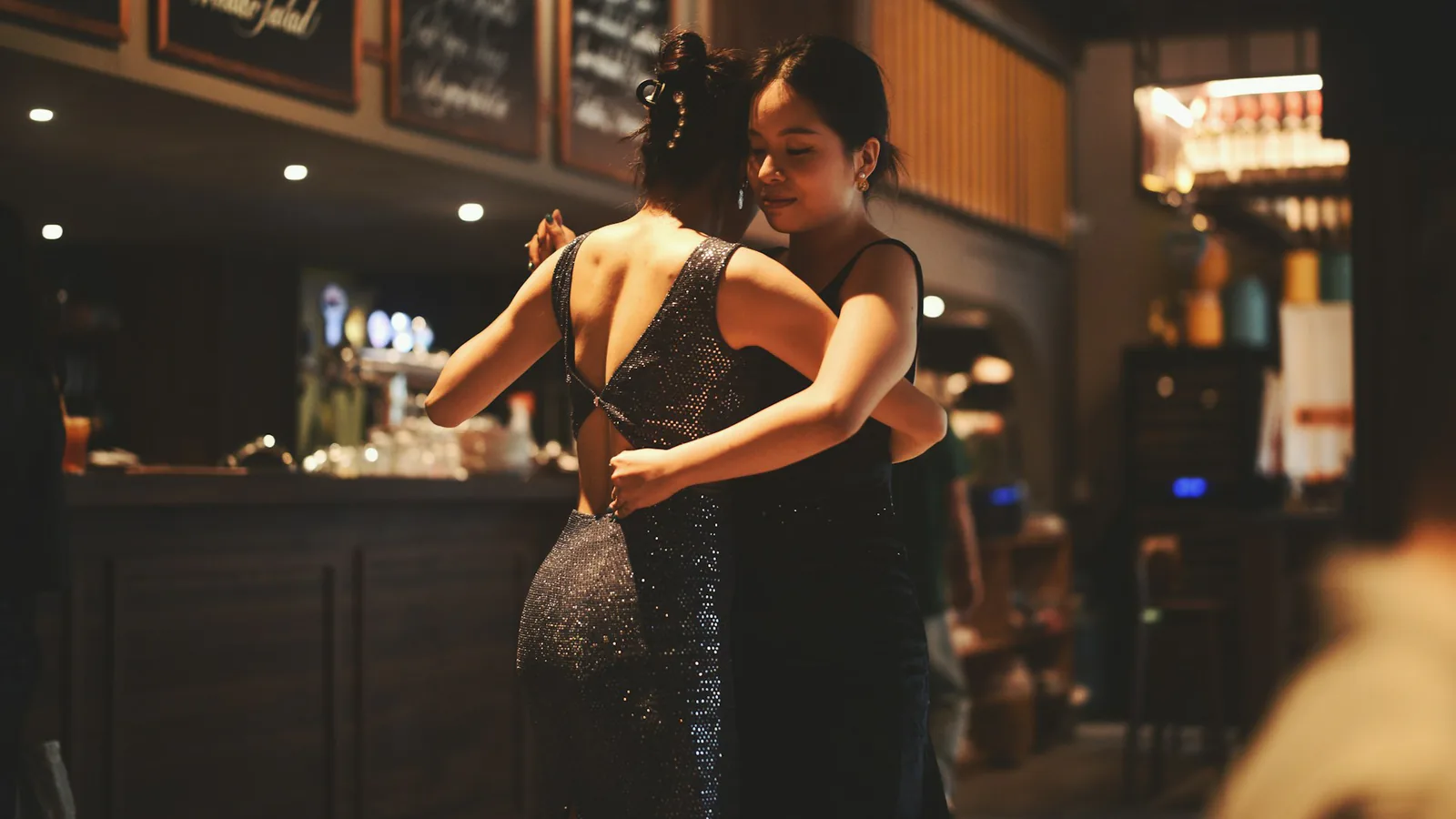
Who leads, who follows, and why that person? Behind the choice of role lies a larger question: what belongs to dancing together, and what do we expect because we perceive someone as a woman, a man or a nonbinary person?
Gender identity describes a person’s internal sense of gender; sexual orientation concerns whom they are attracted to. Gender expression involves things such as clothing, voice and presentation. These distinctions also matter on the dance floor. A dress does not reveal an identity, a woman leading need not take on a male identity, and a man following another man reveals no sexual orientation by doing so. Nor does “nonbinary” mean someone who learns both dance roles. It describes an experience of gender outside exclusively being a woman or a man. People choose their own self-description.
The European Equality Dance Association explicitly separates these dimensions in its definition: people can choose their partners and dance role regardless of sex, gender identity or sexual orientation. Opening up dancing in this way involves several freedoms. Choosing a partner and choosing a role are different decisions.
What an old manual takes for granted
In Modern Dancing, their 1914 manual, Irene and Vernon Castle explain the One Step through a fixed pairing: the gentleman initially moves forward, the lady backward. Alongside his view of the floor, they offer her supposedly greater backward-moving grace as a reason. A movement pattern is thus explained through a gender expectation. Yet the book also calls for light, coordinated dancing and criticizes rough gripping. This historical prescription deserves a closer look than a simple image of male force and female passivity. It records this duo’s teaching ideal, rather than every dance encounter of its time.
In Brazilian Zouk, too, what preserves or changes a tradition is contested. Some practitioners switch between leading and following within one dance. Others regard this as altering the essence of partner dance. Historical research combining written sources and the authors’ field notes documents this dispute. An inherited tradition can contain disagreement and different ideas about a dance’s future.
People create dance spaces of their own
Change also grows from the question of who has a place at all. In 2005, Mariana Docampo articulated the foundation of her Tango Queer project in Buenos Aires, preceded by her classes for women at a lesbian feminist meeting place. Her manifesto challenges the fixed link between sex and dance role; learning both roles is intended to enable choice. She particularly emphasizes the invisibility of women dancing together. For this initiative, choosing a role also concerned cultural belonging. Participants created a place for their own relationships with music and one another.
Independent spaces can later gain institutional recognition. In Germany, dancers, organizers, club representatives, teachers and adjudicators founded the German Equality DanceSport Association in 2008. An agreement admitting it to the German DanceSport Federation followed in 2010. Their collective work gained a recognized organizational form. Coordinating competitions, advising organizers and representing dancers’ interests reach beyond an individual choice of role. These structures help explain why the history of open roles also involves clubs and associations.
The European EEDA embraces both freedom of choice and explicit recognition of the LGBTQIA+ communities from which equality dancing developed. In this understanding, openness also means keeping visible the people and relationships that helped create those possibilities.
Opening roles while recognizing skill
In Brazilian Zouk, this distinction has a concrete competitive form. At registered Brazilian Zouk Dance Council Jack-and-Jill competitions, dancers may enter as leaders or followers regardless of gender or sex. The roles have separate points because skill in one does not automatically imply skill in the other. This clarifies something important: access to a role and experience in it are different questions. Choosing roles independently of gender does not remove the need to learn. These rules govern the Council’s competitions; they do not automatically describe every class or dance party.
The words matter too. The Zouk study describes a shift to leader and follower, alongside debates about initiative in following. This concerns both who forms a couple and what each partner contributes.
Writing from a queer dancing and teaching perspective, Luna Beller-Tadiar develops this connection in tango. In this analysis, following requires perception and interpretation; overlooking that work can wrongly attribute the shared dance to one person. The essay also distinguishes switching roles from their gendered meaning. Some queer dancers deliberately play with feminine or masculine expression; others want to reduce such associations. “Queer” therefore describes no uniform way of moving. Two people may retain their roles while relating differently to their meaning. A visible switch alone does not explain their relationship with dance.
Openness has several dimensions
A 2022 symposium organized by pinkballroom and the German Equality DanceSport Association documents how different needs can meet. Nonbinary participants described women’s and men’s categories as barriers to entry. Others emphasized separate women’s categories in light of their experiences of disadvantageous judging. The report records this tension without pretending there was a shared solution. It shows why relabeling a competition cannot answer every question. Categories, belonging and whose experiences inform decisions are also part of dance culture.
Having a say goes beyond permission to dance. In interviews published by the British dance teaching society ISTD in 2021, consultant Jessica Allen criticized the failure to take transgender artists’ voices seriously in decision-making. Her call for freer expression on stage and in the studio adds influence to the question of role choice. People involved in shaping teaching, representation and access can point out what seemingly self-evident practices overlook.
For an individual dance, this also opens an aesthetic question: how do these two people want to appear and express themselves together? The German Equality DanceSport Association’s mission document explicitly supports different answers, from familiar appearances to couples who do not want to present themselves through gendered role assignments. It asks teachers to support individual preferences. Replacing a fixed prescription with the expectation that every couple must visibly play with gender would be contradictory. Different expressions can coexist.