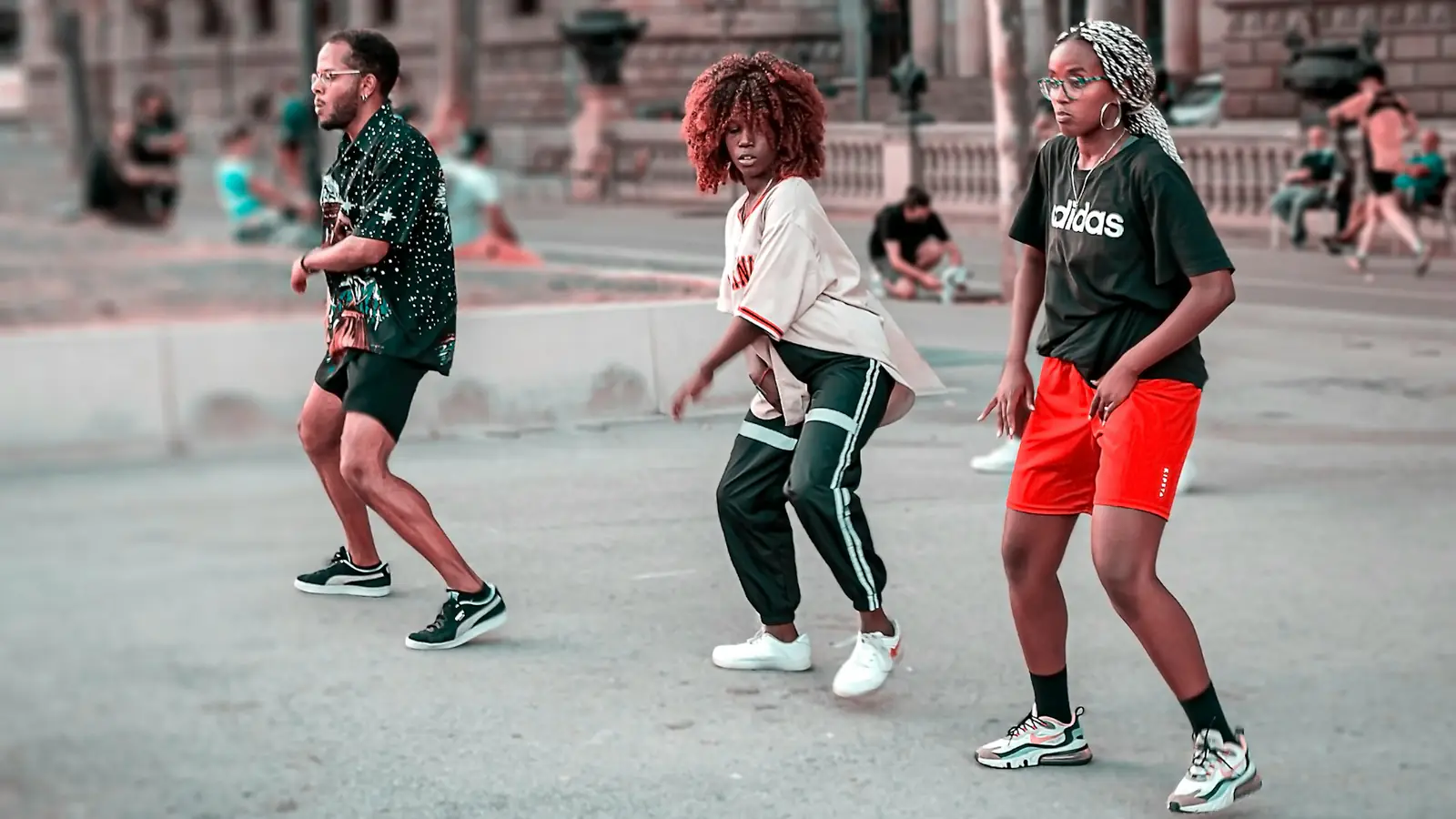
In 2015, Renata Peçanha recalls working with Adílio Porto in Rio de Janeiro around 1994/95. Changing music offered them new possibilities: movements could become longer, include pauses and change their dynamics. For her, experimenting and continuing to develop the dance belonged together.
Her account takes us into a history connecting several places. Brazilian dance practices meet Caribbean music, travelling artists and different ideas about teaching movement. The names change along the way, too.
People dancing Brazilian Zouk today encounter traces of this history in movements, songs and names such as Lambada and Zouk. Understanding their relationship means looking separately at the development of music, social dancing and teaching, then following the connections between them.
Belém and the routes of music
Historian Laisa Epifânio Lopes describes Belém in Pará as a hub of musical exchange. Radio, records and sonoros, local sound systems, brought Caribbean music to local celebrations. There it encountered existing musical preferences and dancing habits.
Lambada’s musical context includes merengue and carimbó, a tradition rooted in Pará. Historical research also describes the importance of electrically amplified music during the 1970s. Musicians worked with existing material and changed its sound. Connections like these develop through concrete work: playing, arranging and trying things out in front of an audience that wants to dance.
A tangible musical reference point is Mestre Vieira’s 1978 album Lambadas das Quebradas. An article on Brazil’s government portal Agência Gov places it within the history of guitarrada, in which the electric guitar plays a central role. The description “instrumental Lambada” also belongs to this musical context.
This helps explain why the word Lambada needs care when discussing history. It can refer to music, a recording or a dance practice. Finding a title on a record answers a different question from recalling how two people moved together on a dance floor.
From local dance floors to worldwide success
The history of Lambada as a partner dance is closely connected to Porto Seguro and neighbouring Arraial d’Ajuda in Bahia. The American Lambada Organization describes a setting of dance venues, performances, competitions and learning from one another. Its account names Braz and Didi dos Santos, along with Didi’s partner Rebeca Ro Lang, among the influential participants.
Kaoma’s success in 1989 brought Lambada to an international audience. For many people outside Brazil, this music became their first encounter with the dance. Researchers Ana Carolina Navarro, Isabela Buarque and Luciano Menegaldo place that media success in the context of an existing Brazilian dance practice and its further spread.
A worldwide hit can create the impression that everything began with it. Recordings and music videos, however, compress a much longer story into a few minutes. They show only some of the people who previously played music, established places to dance or developed movements together.
In newspapers from Pará, Lopes finds debate about Lambada’s regional origins as early as the late 1980s. Cultural recognition and economic opportunities were both at stake.
The Caribbean history within the name Zouk
Zouk music has its own Caribbean history, with Kassav’ playing a central role. The band was formed in 1979; its founding history includes Pierre-Édouard Décimus, Freddy Marshall, Georges Décimus and Jacob Desvarieux. The band’s own biography describes a project to develop Guadeloupean music using the possibilities of modern studio technology.
Local rhythms and professional production were connected in that work. The label biography points to gwoka from Guadeloupe and ti-bwa from Martinique. It describes the early Kassav’ sound as fast and driven by percussion. Anyone who mainly knows Zouk as slow music therefore encounters a broader musical context here.
Cultural writer Bertrand Dicale explains the significance this international success acquired for the French Antilles. Creole language and musical references drawn from everyday life reached major stages. This offered a way to express cultural identity and modernity together.
That matters for the connection with Brazil. The songs carried voices, languages and artistic decisions from another cultural setting. Caribbean Zouk offers a history to explore in its own right, extending far beyond its later use on Brazilian dance floors.
Music can accompany different ways of dancing in different places. Sharing a song or a genre name tells us relatively little about how people organise their bodies, communicate with a partner or name a movement. This openness makes exchange possible, while also inviting attention to the cultures involved.
How the dance changed in Rio
In Rio de Janeiro, other possibilities for dancing and teaching developed from Lambada. Navarro, Buarque and Menegaldo describe the development of linear movement pathways and the importance of slower rhythmic marking. They place these changes within a longer process involving several dance practitioners.
Peçanha describes a forward-and-back basic, draws comparisons with samba de gafieira and bolero, and refers to her ballet and jazz training. In her account, extending and shaping movement remained connected to the Lambada tradition.
A change like this involves more than adding a variation. A different pathway changes how two people move in relation to each other. A pause creates room for another musical choice. A basic that can be explained clearly can become a starting point for a teaching method.
Teaching makes movement repeatable: a teacher names it, breaks down its course and decides what can build on it. That supports the passing on of knowledge. Each selection also directs attention towards particular qualities of the dance. Someone learning that method later encounters a developed perspective on a larger body of movement knowledge.
Routes continued and circled back
In his work at the Universidade Federal do Pará, dance practitioner Evandro Sales describes a notable route back to Belém. According to the recollections he records, local teachers encountered the teaching developed in Rio during the mid-1990s and brought new knowledge home. Junior Carvalho and Marcelo Thiganá are among the names in this local account.
Sales’ own career includes further training in Rio and continued work in Belém. A place whose musical history contributed to Lambada could therefore later receive knowledge from another region. These returning connections help explain why the history is difficult to tell as a straight line from one city to the next.
Other artists’ biographies extend the view beyond this connection. The Brazilian Zouk Dance Council documents Philip Miha’s work in São Paulo and Gilson Damasco’s activity in Argentina from the early 1990s. Schools, events and personal relationships offered different routes for passing on the dance. These biographies provide specific perspectives, although they do not amount to a complete family tree.
What names preserve and change
Names such as Lambada, Lambazouk and Brazilian Zouk carry these connections forward in different ways. Someone using a name may be emphasising musical origins, a local tradition or a particular teaching practice. The same word therefore need not mean precisely the same thing in every place.
The American Lambada Organization highlights continuing Lambada communities while describing Brazilian Zouk as a developed form. Its position challenges the idea that a dance disappears when its greatest period of media attention ends.
Brazilian dancer and researcher Thayane de Araujo Rodrigues, also known as Thay Araujo, describes the work of Quilombo da Lambada in 2025. Its participants advocate greater recognition of Black dance practitioners and their Lambada knowledge.
Rodrigues criticises the separation of internationally marketed movements from their origins and the people behind them. She also questions beauty standards that elevate some bodies and ways of moving while devaluing others.
The development of a teaching method can therefore be viewed from several directions: as work on movement and teaching, and as part of a dance scene in which people distribute recognition, attention and income unevenly.
This gives cultural origins a very concrete meaning. They include names, learning relationships and places. Recognising them also means looking beyond a movement’s best-known presentation today and taking an interest in the knowledge that continues through it.
When music acquires another name
Ghetto Zouk belongs on the musical side of this discussion. In a 2024 interview, Cape Verdean-Dutch singer and producer Nelson Freitas describes how he and his uncle combined Zouk with hip-hop drum sounds in Rotterdam. He is discussing his own work and a name that listeners took up.
His account takes us into the musical life of the Cape Verdean diaspora. The name here describes a musical development. It tells of another connection formed through migration, shared production and the choices of the musicians involved.
A history that keeps moving
Peçanha’s account begins with people responding to changing music. The wider history leads to records and dance celebrations in Pará, dance practitioners in Bahia, Caribbean musicians and later routes of teaching and travel. It reveals how much work lies behind a dance that can feel effortless in a shared moment.
This history brings greater attention to what we hear, dance and pass on. An artist’s name, a song or an account of learning from someone can make a connection visible again. Alongside the pleasure of change, there is room to remember the people who made it possible.