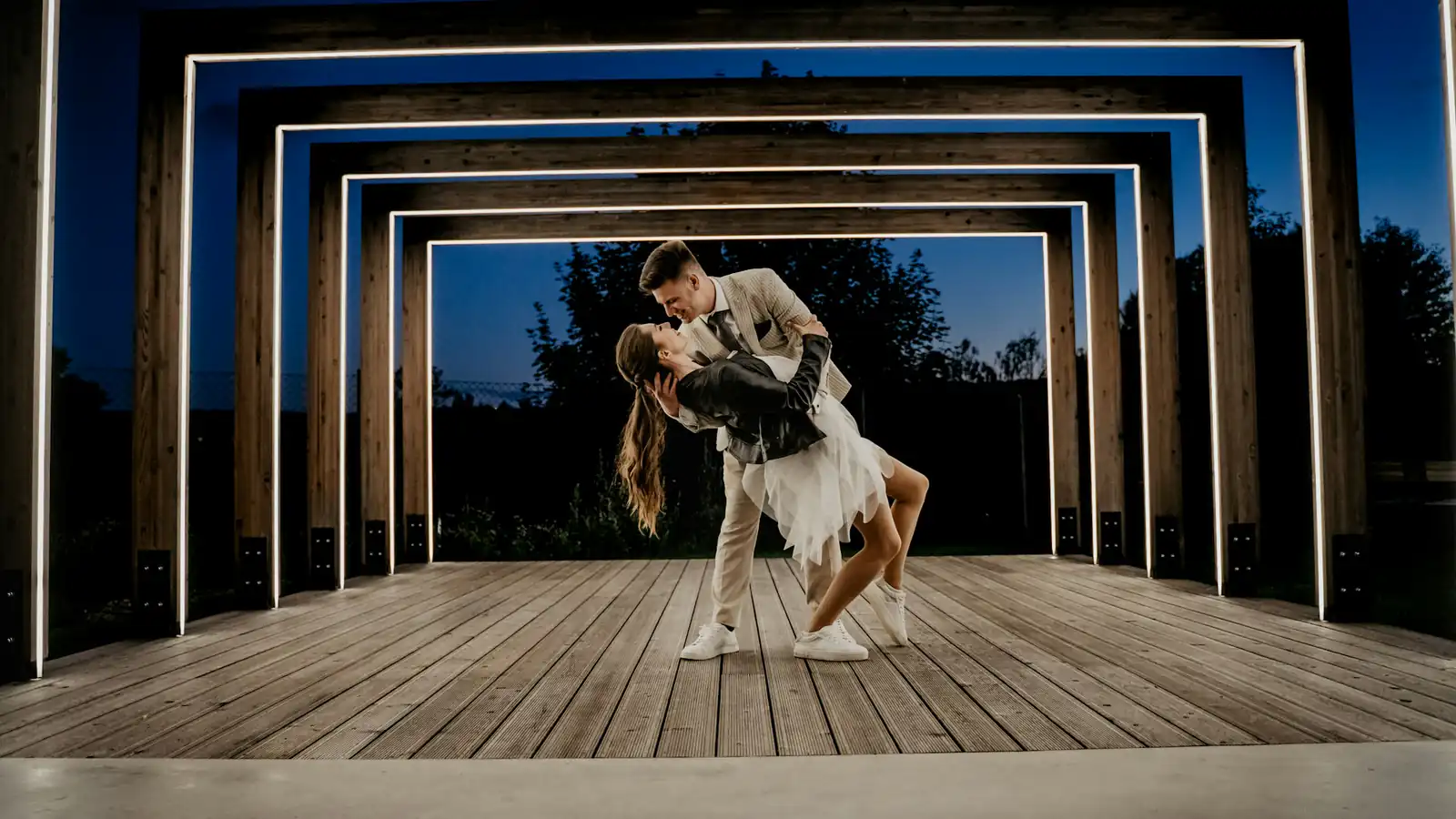
Lambada lives through being passed on. In its own history, the Organização Internacional de Lambada describes how people continued dancing and teaching beyond its period of intense media attention. It presents congresses as places for teaching, music and encounters. In this account, continuity and development belong together. The names Lambada and Lambazouk also become easier to understand when we consider the people who use them.
A repertoire that people pass on
Dancer Maria Mariana from Porto Seguro offers a concrete example. Her public Lambada course outline includes basic variations moving forward and back, sideways and diagonally, as well as walking movements, turns and counterturns. Boneca, Chicote and Cambrê appear as distinct teaching topics. There is also material explicitly addressing slow and fast music. This structure reveals how much the name Lambada can encompass. Tempo alone is therefore a poor dividing line: her programme includes different speeds within the same dance practice. Recognisable movement names sit alongside work on the foundations.
Dance teacher Arthur Santos discusses how this repertoire relates to the name Lambazouk by recounting a conversation with Leo Bruno. In Santos’ account, Bruno stresses continuing features such as Boneca, Chicote, Cambrês and rhythmic continuity. He also describes more systematic teaching: Lambada teachers had explored Zouk concepts and structures and named movements more precisely. Bruno advocates returning to the name Lambada. His position connects changes in teaching with recognition of a continuing tradition. For him, organising the material differently does not have to require a new name for the dance.
What names reveal about their use
A name can serve another purpose in a stage production. In a 2014 interview about her show Brazouka, Pamela Stephenson-Connolly used LambaZouk. She explained the connection between Lambada and dancing to Caribbean Zouk music. The compound name made that connection visible to her audience. That context matters when interpreting it: a producer is introducing a show and explaining its dance foundations. This does not establish a universal boundary between two movement repertoires. Here, the name also tells us something about how dance is presented to people encountering it.
On a shared dance floor, named differences can also become permeable. Paulo Renato Oliveira and Luís Vítor Castro Júnior observed this at the Zouk-Lambada congress in Porto Seguro in January 2009. They described dancers switching between practices or combining them according to the music. Their observation concerns that particular gathering, yet it helps explain why tidy categories sometimes fit shared dancing poorly. People bring particular preferences and experiences while also picking things up from each other. Differences can remain recognisable as the available repertoire expands. Both were part of the exchange they observed.
Culture needs people and occasions
An announcement from Porto Seguro in 2025 shows how closely the name Lambada can connect with belonging. Maria Mariana and Gabriel planned the carnival group Viva a Lambada! Mariana explained her wish for lambadeiros to feel proud of their culture; Gabriel wanted to bring residents and visitors together. With the group, they wanted to celebrate the local dance tradition in public. These intentions help explain why naming reaches beyond movement technique. A name can bring people together, make their work visible and help them pass on something they consider part of their city.