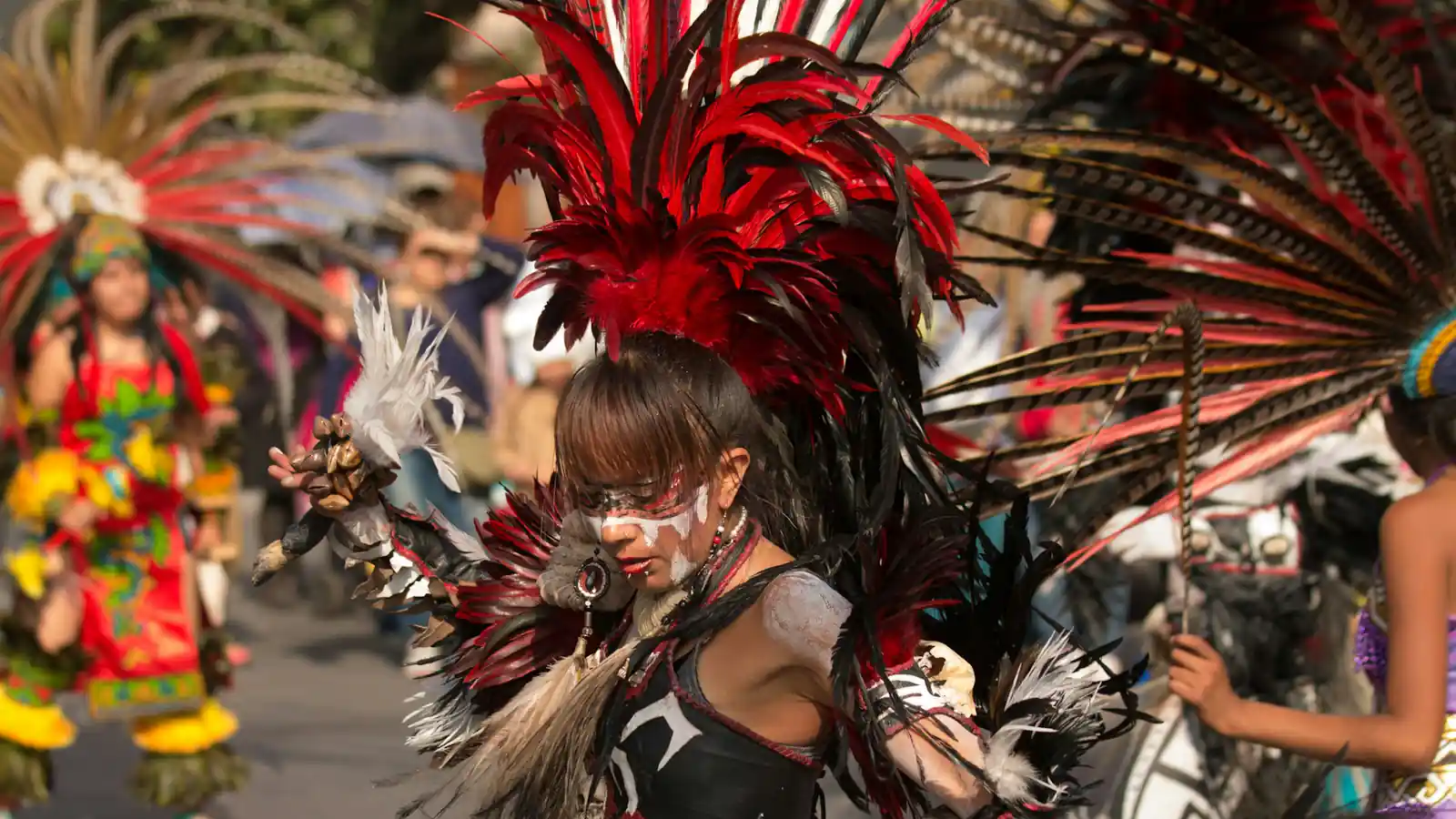
People who travel to Brazil for dance often arrive with something already in mind: a favourite song, a familiar way of moving with a partner, or the name of a teacher whose work has caught their interest. Once there, that interest can grow considerably. A movement name leads to a life story, a cultural centre to a neighbourhood, a conversation to music that has never appeared in your own playlists. A journey becomes particularly rewarding when there is time between classes and onward travel to follow these connections.
Recife, Cachoeira and Rio de Janeiro offer three different ways into this experience. Each provides an opportunity to explore how dance belongs to a place: through its institutions, the people who share their knowledge, and the ways they gather. When planning a trip, it is worth choosing one of these connections as a starting point and giving it some room to develop.
Recife: Frevo gains names and history
The Paço do Frevo stands in the Bairro do Recife, in Pernambuco’s capital. Active since 2014, this cultural centre combines exhibitions with research and education around Frevo music and dance, closely connected to street carnival. Its work continues beyond the carnival season. For a visitor, it offers a useful starting point: an exhibition can introduce connections and reveal the people, groups and activities behind a dance culture encountered in public. Documenting knowledge and passing it on are also part of what happens here, alongside the dance and music themselves.
Frevo has a vocabulary of its own. Its dance practice is also called passo, and its dancers passistas. A historical IPHAN inventory documents a varied repertoire of movements close to the ground, more upright variations and jumps. Names include tesoura, meaning scissors. The inventory also describes the importance of improvisation and individual expression. When watching a demonstration, you can therefore notice more than its difficulty: how a dancer selects familiar movements, connects them and gives them a personal execution. A shared name does not require every dancer to move identically.
The Frevo Vivo exhibition, renewed in 2025, offers several approaches alongside one another. Passista and teacher Rebeca Gondim developed a dance projection with mirrors for the installation Nós no Frevo. Another station allows instruments within a specially created arrangement to stand out; Rafael Marques and Isadora Melo were responsible for its musical design. Banners and memories from different Frevo communities appear alongside these installations. This combination brings physical exploration, music-making and a sense of belonging together within an exhibition.
Eduardo Araújo of the Guerreiros do Passo collective connects teaching with other work. The collective grew out of a project in Praça do Hipódromo. In February 2026, he described educational work that also reaches people with no intention of becoming professional artists. For the Laboratório do Passo, the team sought historical images and conversations with older passistas to revisit movements seldom practised. Araújo connects this research with continuing classes and the history of street carnival. Repairing umbrellas also forms part of the collective's work. His account makes the preparation behind an apparently effortless living tradition tangible.
A small notebook can be a useful companion during this stay. Alongside unfamiliar Portuguese terms, you can record names and specific discoveries: a teacher whose explanation made sense, a movement whose effect surprised you, an instrument you would like to hear more closely later. This creates a personal connection between what you encounter and what you want to learn. If you subsequently take a class, you already have something to discuss. You can name an observation, ask about its use and more readily understand what a demonstration refers to.
Cachoeira: A Casa holds shared memories
In Cachoeira, in Bahia's Recôncavo region, the Casa do Samba de Roda de Dona Dalva opens up a different context. The public museum register describes a community centre for education and memory, with instruments, photographs and clothing. Its history is connected to the women who made cigars for Suerdieck and to the Samba sustained by Dona Dalva. Documented activities include rehearsals and the transmission of singing, instrumental playing and dance. The children's group Samba de Roda Mirim Flor do Dia shows that sharing this knowledge has its own dedicated place.
Dona Dalva told the university publication Reverso about her grandmother, who collected contributions for the celebration of the Irmandade da Boa Morte and took her along as a child.
Family, faith and belonging are closely connected in this recollection. The singer and sambadeira, or Samba dancer, speaks about people she grew up with and a community she grew into. For someone discovering Cachoeira through dance, these are life stories that extend beyond the moment of a performance. A celebration acquires meaning through the people involved in it.
The expression samba de roda also becomes more specific in its local context. Roda means circle. Ethnomusicologist Caio Csermak, who conducted research in Cachoeira, explains that it brings together different local names. Participants may speak of corrido, chula or barravento. He understands dancing, singing and playing as closely connected activities. This changes what deserves attention: noticing a singer's entrance and other people's responses reveals another dimension of the gathering. The circle has an audible and moving order whose details become clearer in the particular setting where it takes place.
The Recôncavo extends around Todos os Santos Bay. The 2021 IPHAN technical report reassessing Samba de Roda illustrates how specific such differences can be. In the forms it describes, singing and dancing may happen together or alternate. For the Barravento documented in Cachoeira, it explains the change to instrumental accompaniment while one person dances. This gives visitors a useful starting point for observation. A pause may create room for someone else. Following the activity for a while makes it easier to recognise an opportunity to participate and the roles held by the other people present.
The Casa also takes part in current social activity. In September 2025, Instituto Odara reported on a gathering of Black women from the Recôncavo at the Casa do Samba de Dona Dalva. They were preparing a joint political mobilisation, discussing participation and accessibility among other concerns. Activist Iasmin Gonçalves explicitly connected caring for Samba and inherited songs with the recognition of Black culture. In this account, the house is a place where cultural practice and present-day concerns meet, sustained by people who bring both into its rooms.
For a visit, it is therefore worth making time for the people who run a place. A collection of clothing may initially look familiar. Conversation can draw attention to its materials, the occasions it was worn and its former wearers. The same applies to a photograph: alongside the visible scene, names, relationships and circumstances become interesting. Encounters like these do not require grand questions. A sincere interest in an object or a story provides an opening; how far the conversation develops is something both sides decide.
Rio: A dance venue is part of the city
At MAM Rio, the museum of modern art in Parque do Flamengo, the architecture itself provides a reason to pause. The museum’s guide describes the relationship between Affonso Eduardo Reidy’s building and Roberto Burle Marx’s gardens. Fourteen large supports, known as pilotis, hold the upper floors above an open ground-level area. The gardens lie beside Guanabara Bay. Here you can consider the relationship between a building and the people who use it: the open area belongs to a museum visit just as much as the exhibition rooms above.
Dance featured in the programme on 16 August 2025: Alexandre Silva and Jéssica Cassimiro introduced fundamentals of the partner dance Samba de Gafieira, followed by live music from Gafieira Botânica.
For Samba de Gafieira, different ways of learning also deserve attention. Aline dos Santos Paixão and Elisângela Chaves studied Rio's professional scene through interviews and observation in 2018 and 2019. Their study describes knowledge from families and dance halls alongside organised teaching and younger approaches to professional practice. It also records younger professionals returning to learn from older dancers. These encounters concern movement, naming and understanding. Experience travels between different people and places, while the ways it is shared change along with them.
This is useful when choosing a class. One teacher may break a combination down carefully; another may first demonstrate it within the music. Both offer something you can use in your learning. When making contact, describe your experience and interests as specifically as possible. If you come from Brazilian Zouk, you can explain that while remaining open to how another partner dance feels. Familiarity with learning as a couple can help you settle in, while new habits deserve attention of their own.
In January 2026, #estudeofunk brought activities including Passinho from Rio’s Funk culture with Celly IDD and Laranjinha and a dance workshop on Funk history with Taísa Machado to MAM.
Dancer and researcher Taísa Machado connects movement in her Afrofunk Rio project with conversations about history, racism and gender relations. Débora Britto's 2018 interview report shows how Machado places the cultural production of peripheral communities at the centre of her work. For travellers, this opens another perspective on Rio: an interest in dance can extend to the people who explain it as art, develop it and represent it publicly. Their perspectives form part of an encounter with the city and the cultural work taking place within it.
Giving an encounter enough time
Your own journey does not need to become a long list. A place with a suitable programme can give shape to several days: first watching and listening, then trying something, and later returning with a better understanding. Leave space between these experiences. A packed timetable leaves little opportunity to find unfamiliar music again, continue a conversation or follow a discovery beyond your original plans.
Preparation includes a few simple Portuguese phrases and direct contact with the relevant centre or teaching team. Establish which public activity fits your dates and how participation is arranged. At a community-run institution, that may mean agreeing on a visit in advance. It also helps to explain briefly what interests you and how much dance experience you bring. This allows your hosts to judge whether their format is suitable.
What stays with you from such a journey can be quite specific: a movement name you understand, a voice whose story you have encountered, or a place you hope to revisit. These become a personal way into Brazil, gaining new detail with every further encounter.