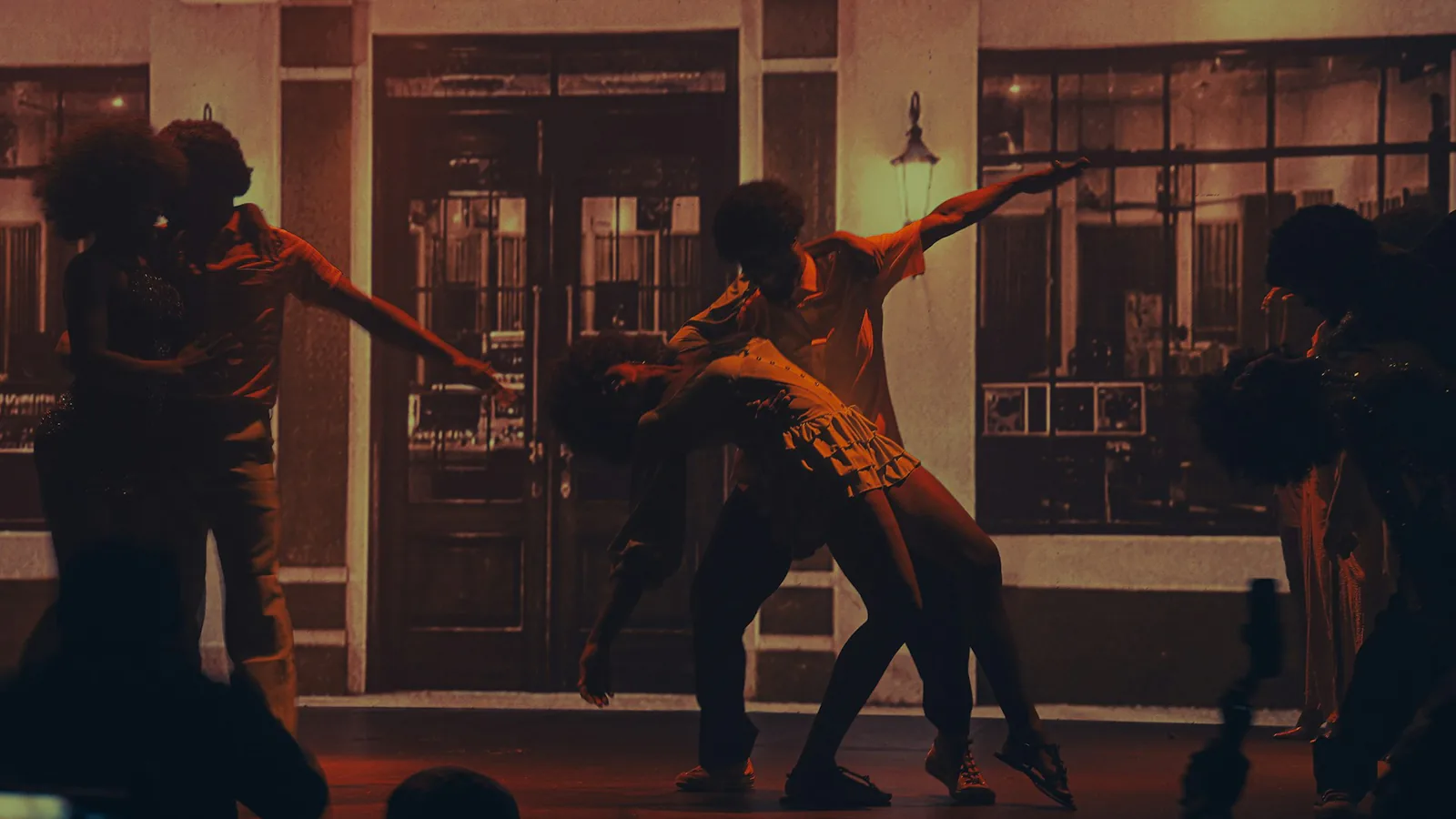
Imagine two people dancing to the same song twice. The first time, they respond to a clear musical accent. The second time, they let that moment pass because a movement they are sharing is still unfolding. Both dances can make sense. That possibility of choosing is part of what makes partner dancing interesting: how much can be prepared, and what only happens when two people actually meet? Brazilian Zouk offers many ways to explore that relationship.
The dance has its roots in Lambada. Renata Peçanha describes its development as an evolution of an existing dance culture, one she worked on with Adílio Porto. That connection is part of its identity.
Caribbean Zouk is a distinct musical tradition. Brazilian Zouk here means the partner dance developed in Brazil.
A movement language for the whole body
There are recurring names for the movement repertoire. The Brazilian Zouk Dance Council lists Frente e Trás, Lateral, Viradinha, Bônus and Soltinho, for example. Frente e Trás, meaning forward and back, already points to a simple spatial relationship. Such terms give movements names that dancers can use to communicate. Knowing them makes a conversation about Zouk more than a string of unfamiliar words: it becomes a discussion of material that can be used to shape a dance together.
Renata Peçanha describes opening into a sideways corridor in the Lateral. She also explains her preference for projecting movements further and giving them more length, connecting this to her background in classical dance and jazz. Spatial organisation and an individual artistic voice work together.
The range extends beyond travelling and turning. In his teaching approach, Alex de Carvalho distinguishes body waves, isolations and head movements, among other elements. An isolation brings the movement of one body area into focus relative to others; a wave connects successive movements into a progression. Their quality can change too: connected and flowing, or brief and sharply accented. The internationally used terms body movements and head movements describe areas involving different techniques, rather than a required feature of every dance.
Another characteristic is elasticity: an interplay of stretching and returning within the connection between two dancers. Think of them moving a little further apart, then developing a movement back towards each other. Both people take up that change together. It can give a familiar basic variation a different dynamic. Elasticity here describes a quality of interaction, rather than the greatest possible flexibility of an individual body.
Distance changes the possibilities too. An open hand connection leaves space between dancers; a closer embrace creates different points of contact. Open hold and close embrace are familiar terms for these arrangements. Transitions are part of the dance: one hand connection can release and another form while the shared movement continues. Both people's comfort with closeness remains essential. Distance alone says little about how attentively or musically a couple is dancing.
Two roles, two active participants
Leading and following describe different tasks: the leader proposes a change; the follower perceives it and carries it out with their own body. Both adjust to each other. Height and arm length enter into this process, alongside experience and musical preferences.
Following involves skills of its own. In an article on teaching, dance teacher Laura Riva stresses that followers also need to understand how they transfer weight, delay a movement or organise their bodies. They need a sense of their own contribution. This helps explain why the same lead can look different with different people. A follower processes a proposal, makes decisions in its execution and contributes to the quality of the result. Both roles involve technical work.
These roles can also be learned regardless of gender. In a 2017 interview series, teacher Kendra Haynes describes increasingly speaking about roles in her classes instead of women and men. She encourages people to experience both sides. The series includes several women who teach and dance both roles. Their experiences make a different arrangement quite tangible: before a dance, people can establish who would like to take which role. There is no requirement to dance both every time.
An answer from Jaime Arôxa shows how much personality following can accommodate. Asked what makes a good dance, he describes a partner who is creative, surprises him and brings her own relationship with the music. This fits an understanding of partner dance in which both people contribute. A proposal can be taken up and returned with an unexpected nuance. The roles provide orientation, while expression and attention remain present on both sides.
Connection need not depend on creating a particular mood. Attention can mean waiting longer or letting go of an idea. Sometimes saying something helps. A dance can be playful, focused or reserved; a prescribed emotional intensity would leave little room for the encounter.
Improvisation grows from familiar material
Gui Prada distinguishes foundations, movements and skills for modifying them. These include direction, size, speed and transitions. Floorcraft means navigating and sharing the dance floor. Improvisation takes on a tangible meaning here: familiar material is adapted to a particular situation.
Even a single movement name can contain several possibilities. District Zouk describes different versions of the Giro Simples, a simple turn, and the Soltinho in its repertoire. For Soltinho, for instance, the school distinguishes variations with and without the leader turning. A name helps communication without specifying every detail. It therefore makes sense to consider the particular variation and context when discussing a movement. The same basic movement can develop into different combinations.
Suppose a couple has room to give a passage a spacious interpretation. Later, closer to other dancers, they express the same idea more compactly. Both versions can be expressive. What matters is how they communicate and use the changed space.
Repetition can also be a deliberate choice. Returning to an idea gives the other person an opportunity to recognise it and respond differently. If every event were immediately displaced by something new, there would be little time to develop anything together. When watching a dance, it can be rewarding to notice recurrence: small changes within familiar material, a moment the dancers find together, and the way the next movement emerges from it.
Music gives the dance its character
One common timing is slow, quick, quick: three weight transfers in a rhythm with one longer and two shorter time values. The placement of this pattern within the music can vary between approaches. This provides a rhythmic orientation that can be combined with responding to melody and accents.
Getúlio Ramalho describes music as a central motivation for his dancing. In an interview, he explains how his feelings and movements change with each song. Alongside timing, there is character: the same person can dance with restraint or with considerably more emphasis.
DJs and producers also contribute to the musical range. In 2017, DJ Dravid Shiv described how demonstrations to unfamiliar musical genres, alongside new productions and remixes, expanded his scene's repertoire. He describes a search for music suitable for Brazilian Zouk across genre boundaries. This helps explain why Zouk dance floors can have different musical identities. A DJ's selection becomes part of the conditions to which dancers respond that evening.
In another interview, Leo and Becky emphasise that different music need not automatically imply a separate dance style. For their own work, interpreting the song is central. This perspective invites a closer look at variety: perhaps two couples differ in their movement quality, or perhaps they are listening to different musical elements. Giving that difference a new name is only one possible description. A shared repertoire still leaves plenty of room for individual choices.
Imagine a recording with a clearly audible voice and a regular accompaniment. One couple might emphasise the accompaniment, another follow the vocal line. Neither choice has to last for the whole song. The change itself can be interesting: listening also involves making a selection together.
Dance culture between encounter and creation
The stage is another part of Zouk culture. In 2017, Kadu and Larissa discussed choosing music for a powerful dance piece. Larissa described the interplay of movement, costume and other creative elements. Such work develops with a particular performance in mind.
That context matters when watching: a rehearsed performance and a dance taking shape between two people involve different tasks. Stage details can be developed over time. On a shared dance floor, immediate responses also count. Focusing only on the most striking moment can obscure the decisions in between.
A living dance culture also depends on people who select music, pass on movement knowledge and invite others to dance. Their work takes different forms and pursues different aims. You can admire an artist's distinctive approach without measuring every movement of your own against it. Brazilian Zouk can be explored with curiosity about those differences: a shared activity in which repertoire, music and two personalities enter into a new relationship each time.