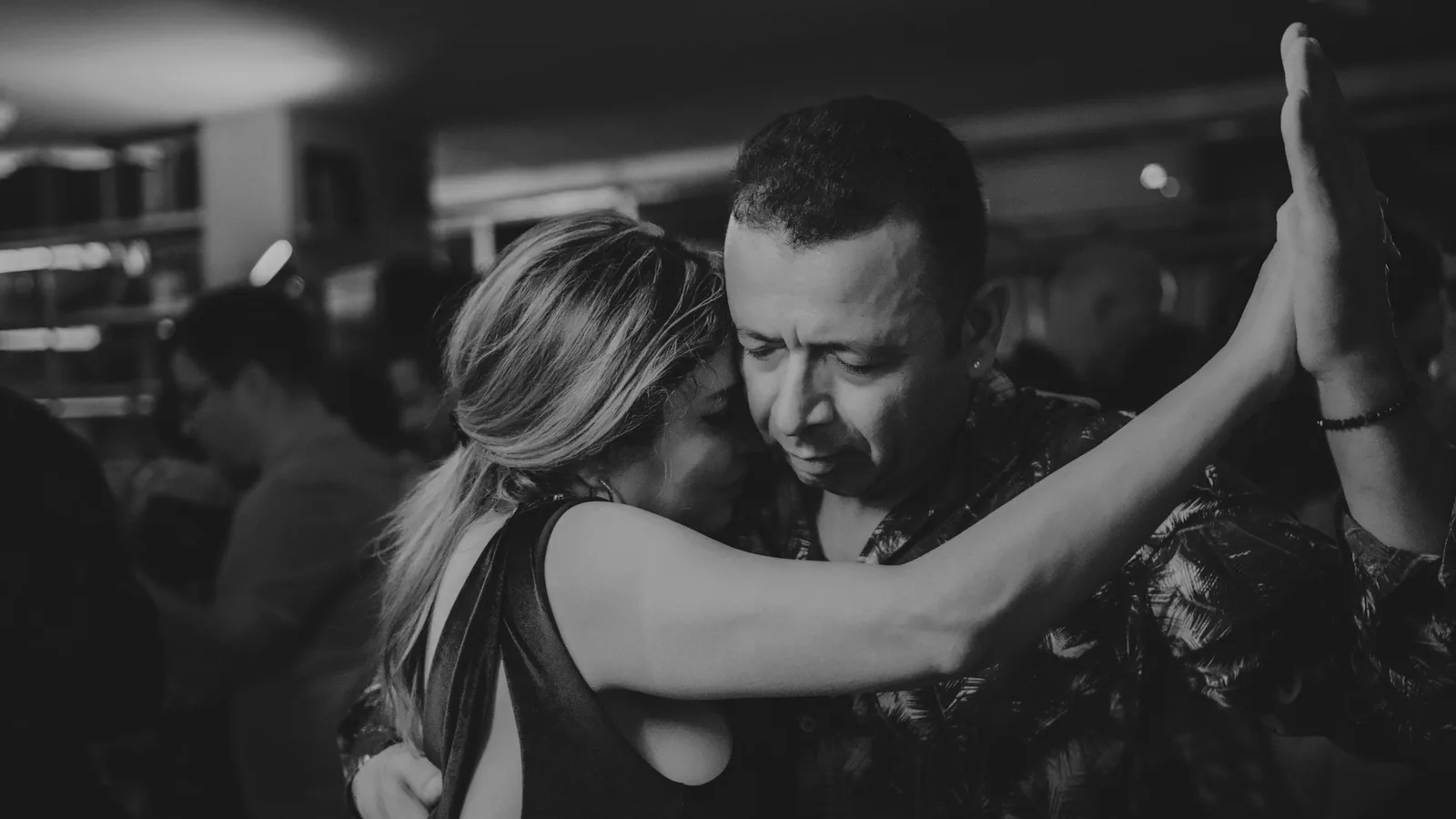
Perhaps the music is what first draws you in as you watch. Perhaps you want to dance with someone already on the floor, or you are curious about what moving together feels like from within. This need not become a major decision yet. A much smaller intention is enough for a first dance: you want to explore what you and another person can do together. Whether this becomes a regular hobby can wait. For now, there is this one beginning, and the chance to give it a form that suits you both.
In her tango ethnography, Federica Banfi describes a change of perspective: newcomers watch a demonstration and try the footwork they have seen. When they then dance in pairs, coordinating their movements with another person becomes an additional task. What they could previously watch now has to happen between them. Banfi describes particular classes, not a sequence that applies to every dance style. Yet the example makes an important distinction visible: recognising a movement and participating in it are different experiences. At the beginning, they may still be a long way apart.
A small shared intention
You can agree on a modest first attempt. If you are both starting out, this might mean trying a basic pattern you have already encountered. If one person has more experience, the other can still say what they know and what they would like to try. A simple “I have never danced this with a partner” describes the starting point more accurately than apologising in advance for the entire evening. You need not present yourselves as confident or exceptionally easygoing partners. You can begin this dance with the experience you actually have.
Beginning together involves more than an observer may notice. In a video analysis of a Lindy Hop class, Mathias Broth and Leelo Keevallik show participants moving from watching to dancing: they orient towards each other, form couples and prepare to start. Instructions and a count-in provide a time frame, while partners also respond to one another. The study describes a particular teaching sequence. For a first dance, it draws attention to something concrete: before a move begins, getting ready together needs room too. You can deliberately allow time for that moment.
An invitation is initially about this dance. Saying yes, saying no and stopping later must all remain possible. That establishes the terms on which you can explore something together.
What a few basics contain
District Zouk’s published introductory curriculum shows how much a simple dance already involves: alongside basic patterns, it includes timing, leading and following, and navigating the available space. This is one provider’s selection, not a universal teaching order. It does, however, show why a long list of moves offers only a partial account of getting started. When you dance a small amount of material together, the underlying task remains: it happens to music, between two people and in a particular place. Even a familiar basic pattern therefore involves more than its outward shape.
In Brazilian Zouk, names help distinguish this material. Embrace Zouk’s public glossary lists Básico no Lugar as Basic in Place and Básico para o Lado as Side Basic, for example. These names refer to basic patterns rather than individual footfalls. The glossary also acknowledges variations in terminology between teachers. For your first dance, a shared understanding of a pattern therefore matters more than confidence in its name alone: different words may still refer to the same basic pattern. The name by itself does not tell you how you will dance it together.
Dancing together does not require both people to know the entire sequence in advance. Saul Albert’s analysis of a Lindy Hop performance shows an interplay between familiar patterns and movements coordinated in the moment. Music and participants’ visible responses help organise what happens next. This is a demanding performance, not evidence about first attempts at dancing. Yet the distinction between familiar material and its shared unfolding is useful: you may know a basic pattern while discovering, as you dance, how you can continue together. Your partner’s response is part of the emerging dance.
When it takes another turn
Swing teacher Bobby White describes a relevant teaching moment in his introductory article: students accidentally dance something other than the move they were shown, yet what emerges still works as a movement. He places this within swing’s scope for creativity. That does not make every departure successful or replace technique. It does leave a generous possibility open: an unexpected turn need not immediately count as a failed dance. If your small attempt ends differently from what you intended, you can first notice what actually happened before making an overall judgement.
You can equally decide to stop at this point. Perhaps you want to stand still for a moment, say something or finish for today. Give this decision the same weight as your original wish to begin. Your thanks can be for precisely what you shared: your time and your willingness to try together. Even a somewhat awkward dance can end with that simple courtesy.
What you know after this dance
After the dance, you can describe the experience more precisely than simply calling it good or bad. Perhaps you enjoyed the music and moving together still felt laborious. Perhaps you would like to repeat the same basic pattern before adding anything new. Or that one encounter may be enough for today. These descriptions capture what you take from the attempt. They offer a more concrete starting point for your next decision than a hasty answer to the larger question of whether dancing is for you.
You began together, tried something and brought it to an end. That already makes a complete encounter, even if it was brief. You can leave it as that or return to it in another dance. Both choices allow the first attempt its own value. And if you find yourself at the edge of the floor again, those possibilities remain yours too: listening, watching, enjoying the evening and deciding for yourself when you would like to join in again.