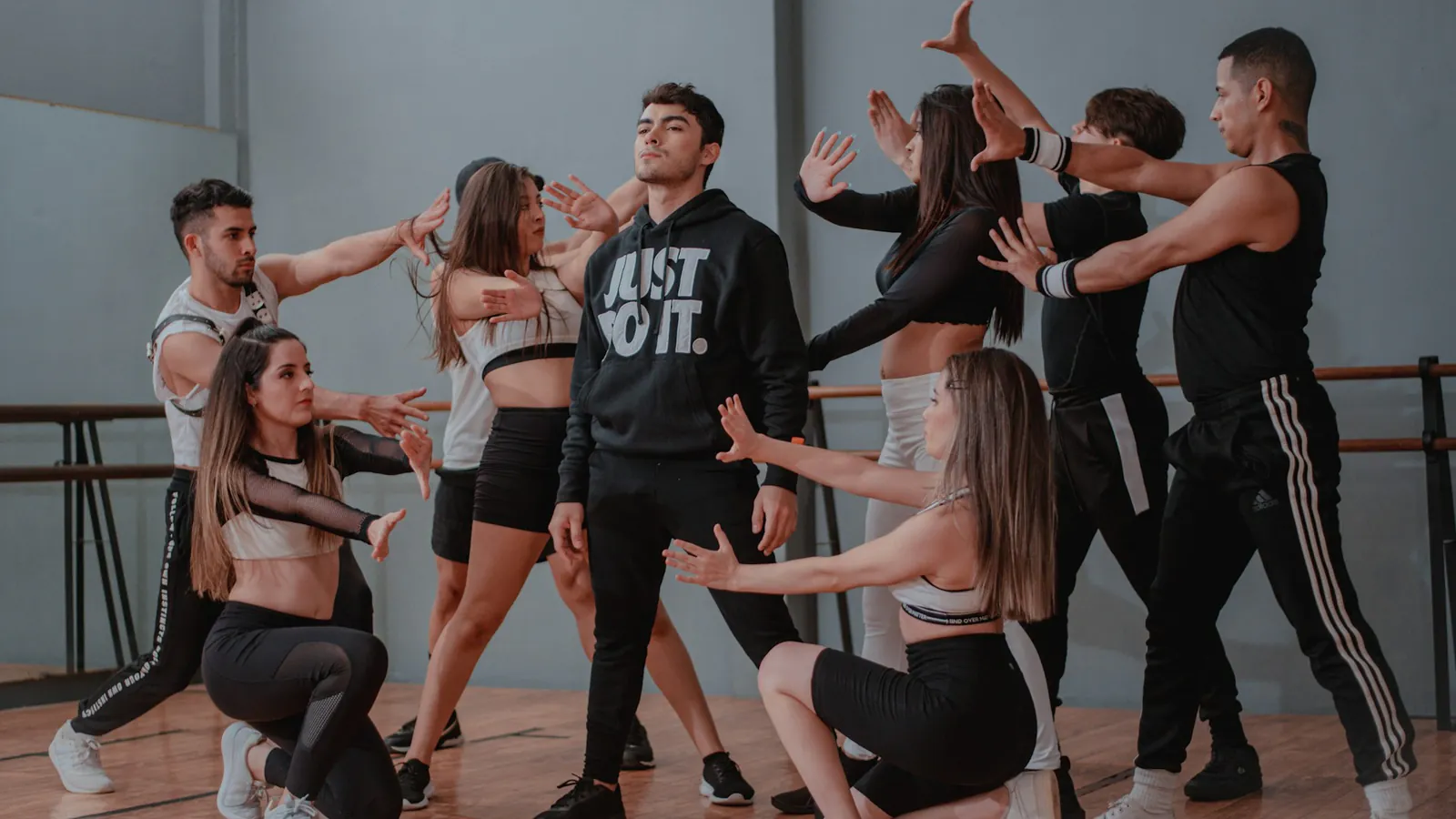
Reproducing a combination and developing original movements are different tasks. Teaching therefore needs different reference points for judging what has worked. Learning goals, teaching methods and assessment belong together in planning. If a particular sequence should remain recognisable, teaching needs to make its features accessible. When the aim is original composition, learners need opportunities to try decisions and consider their effects.
Demonstrating movement and making it understandable
A demonstration presents a sequence as a connected whole. Bettina Bläsing and her team investigated what this means for reproduction: eighteen dance students learned one phrase first from a video and another first from a spoken description. Starting visually produced more complete reproductions and closer resemblance to the model.
Individual interpretation was assessed separately. Here, the expected advantage of starting with words was not confirmed. Each phrase was then presented through the other format as well. The findings give teachers a reason to distinguish accurate reproduction from individual interpretation when assessing learning.
When learners develop their own movement ideas, instruction has a different purpose. In its Creative Dance teaching material, Hong Kong’s Education Bureau describes both direct instruction and discovery learning. One example extends the imitation of flapping wings: children explore flight paths and changes in shape.
The teacher sets a theme within which different responses are possible. Designing that task and responding to ideas are also part of teaching. Learners make decisions about their movements. This example belongs to school-based Creative Dance pedagogy; specific dance forms have their own requirements.
Feedback needs a clear reference point
A correction identifies something that can change on the next attempt. An open question invites learners to examine their own performance. The two have different functions. At Codarts, Benjamin Soerel and his team found considerable differences between the classes and rehearsals they observed. The improvisation class contained far more open questions than the other classes. That observation does not establish a learning effect. It does reveal different forms of conversation within teaching, with the particular task helping to shape which forms are used.
The wording of a cue also matters. In an experiment by Gabriele Wulf and her team, 48 children practised soccer throw-ins. Feedback directed at movement effects after every attempt produced better ratings of movement form at a changed target distance than the other conditions. There were no significant group differences in accuracy or tests at the original distance. A limited implication for dance teaching is useful: feedback quantity alone describes its quality inadequately. What the words direct attention towards also needs consideration. This experiment cannot establish a fixed correction frequency for dance.
Practising and returning to what was learned
Teaching also involves arranging opportunities to practise. In a study by Maurizio Bertollo and his team, forty schoolgirls practised rhythmic foot sequences on a dance-game mat. One group repeatedly practised the same sequence before moving on; the other alternated between three sequences. Immediately afterwards, the first group performed better; three weeks later, there was no significant group difference. The task involved screen cues and rhythmic contact with marked spaces. For teaching, it illustrates a distinction: performance straight after practice and after a break need separate assessment.
Conversation can also reveal how learners engage with the material themselves. Dance educator Victoria Dobson describes including original movement ideas and discussions around a theme in her elementary-school teaching. She aims to accommodate children’s different capabilities while encouraging them to think. Someone explaining an idea contributes something to the class that simply repeating an instruction would reveal little about. The teacher can respond to those thoughts, and learners have an opportunity to express their artistic decisions more precisely.