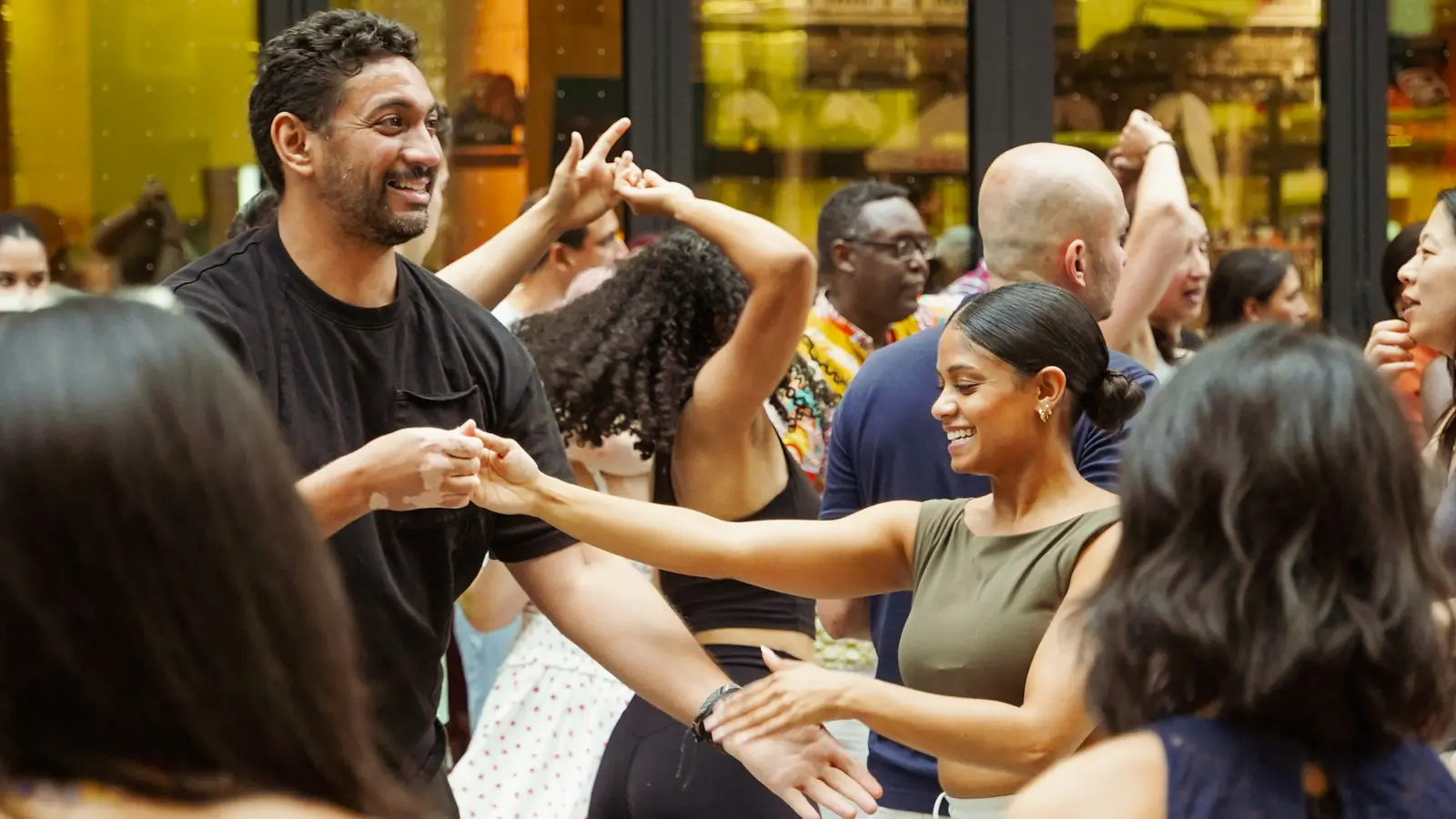
Two photographs can show the same starting position and the same final position. What happens between them remains invisible. Perhaps the journey was rushed; perhaps it unfolded unhurriedly. The next movement might have followed immediately, or there might have been a clear pause before it. In dance, this space between positions gives a movement much of its character. A beautiful line in a photograph therefore tells only a small part of the story. The rest lies in time, in transitions and in the relationships between different parts of the body.
When we speak of flowing movement here, we mean this physical, visible unfolding. The word describes a quality that can take different forms. It might appear in a wide arc or in a small movement on the spot. Fast passages can also feel fluid. The interesting questions begin where the simple label “soft” stops explaining enough: how does a movement develop, and what connects it to whatever follows?
How speed changes a journey
A precise description benefits from some terms used in physics. Velocity includes both speed and direction. Acceleration means that velocity changes: when speeding up, when slowing down and when changing direction. A hand moving around a circle at a constant speed is therefore still accelerating. That may sound unfamiliar in everyday language. It helps explain why a movement that looks rounded can involve acceleration throughout. Another relevant detail is how those changes are distributed over the time available.
Imagine an arm whose hand travels from a low position to a higher one in two seconds. In one version, the hand covers most of the distance near the beginning. In another, it starts gently and moves faster later. The endpoints and the total duration remain the same. Yet the two versions suggest different things: an early departure followed by a long settling, or a gradual gathering of movement towards its arrival.
Movement research also examines jerk, the rate at which acceleration changes. In a classic investigation involving nine people overall, Flash and Hogan described horizontal arm movements using a model that minimises jerk over the entire trajectory. The hand first gained speed and then slowed between two targets; constant speed was therefore no requirement for a smooth trajectory. The model matched many features of the measurements, though it did not explain every detail. These were constrained laboratory arm tasks, not an assessment of dance quality.
For the imagined arm, a whole range of expressive choices remains available. The movement can gather pace early and settle gradually. It can hold back and become more pronounced towards its end. A musical entrance might be marked by the arrival or by the beginning of the gesture. Asking only whether the hand reached the upper position on time overlooks these differences. Timing also concerns the journey towards the chosen moment.
The transition belongs to the figure
A figure can be recognised by its distinctive positions. Dancing it, however, involves more than reproducing those positions one after another. Every arrival has a journey behind it and opens particular possibilities for continuing. A transition is therefore a part of the movement in its own right. It has a direction, a duration and an expressive purpose. Including these spaces between positions lets us describe even a familiar combination more precisely than through its sequence of figures alone.
A simple spatial example makes this clear. A hand reaches an imagined point from the left. If it is then to continue towards the right, its existing path can carry on through that point. If it is to move upwards instead, its direction has to change. Reaching the same place does not, by itself, make the transition identical. A sketch merely shows two lines meeting. In the unfolding movement, we also need to consider how one becomes the other.
This perspective also changes how we regard a combination. Three familiar figures can be treated as three separate statements. They can equally form a longer passage in which the ending of the first already takes up the direction of the second. Both are possible artistic choices. The difference need not depend on the size of the repertoire. A simple sequence already offers plenty to explore when its connections receive as much attention as its most noticeable moments.
Whether an interruption belongs to the intended sequence matters for measurement too. A methodological paper on movement smoothness stresses that a score can only be interpreted meaningfully in relation to the task. Planned intermediate stops should not simply be treated as poor coordination. The paper develops and examines analytical methods, mainly for bounded movement tasks; it provides no aesthetic ranking of dance styles. A deliberately placed stop therefore deserves a different interpretation from an unintentionally hesitant transition.
A pause can also be shaped as part of the statement. A couple might allow a movement to settle, let a shared moment stand and then begin something new. The clear division itself may suit that passage. Treating “flowing” as a constant instruction to keep moving would be an unsuitable aim here. The more interesting choice might concern the carefully shaped arrival before the stillness and the character of the eventual departure.
Coordination has several voices
So far, we have mainly considered a hand. Its path also involves the movements of the arm and the position of the body. The same hand position can be reached with the elbow bent differently or with a different orientation of the upper body. Once again, the visible destination describes only part of the task. Coordination concerns the relationship between the movements involved, including their spatial arrangement and their timing.
As a dance image, consider a wave appearing along an arm. The imagined movement gets its character from neighbouring areas taking part at different times. If each area reached its own highest point simultaneously, the sequence would look different. Such a wave can therefore be described as change organised over time. This image helps us understand a movement quality; it does not prescribe a fixed sequence for every waving movement in dance.
Timing can also call for simultaneity. In another passage, both arms might open a shape together while the upper body keeps its orientation. A different idea might leave the arms quiet and give priority to travelling through space. Flowing movement therefore does not require a constantly moving whole-body picture. Deciding which area carries the statement and which remains understated already changes how the movement reads.
Two bodies, one shared passage
A 2024 study examined how two people's free dancing becomes coordinated. The analysis included 35 pairs without dance training. Depending on the condition, they heard the same or different music and could or could not see each other. Shared music and visible partner movements increased synchronisation in different movement components. Their coordination therefore had several layers. Participants danced without physical contact and stayed within marked areas. The findings explain neither leading techniques in partner dance nor which forms of coordination feel pleasant there.
For a dance illustration, imagine two people shaping an arc through space together. They need not cover the same distance. The person on the outside may have a longer path than the person on the inside. In this example, a shared passage means that different journeys fit together. Imagining a couple as two identical copies in motion would fail to account for this spatial possibility.
In dancing with physical contact, the visible picture is joined by the experience of the people involved. The way a transition looks should not become more important than the comfort of the people dancing it. If a continuation does not work for both people, the idea can become smaller or end. Insisting on maintaining a long line at all costs would be a poor criterion. An improvised connection is also an offer to the other person, rather than an already finished picture they must fulfil.
A musical phrase has room to breathe
Movement to music need not start afresh on every beat. A study of 18 adults, predominantly students with musical experience, recorded their movements to a blues progression played at different tempi. The analysis identified movement periods of one, two and four beats, sometimes occurring simultaneously. Often, one level dominated at a time. This demonstrates a possibility for temporal organisation, not a fixed allocation of body parts to counts. The limited sample and single musical stimulus cannot establish a general rule for all music and dancing.
An individual musical interpretation invites a question: how long should the chosen movement last? A hand gesture could highlight one sound. A longer passage might span several beats and arrive at the end of a sung line. In this imagined example, the pulse remains a reference without dictating the duration of every gesture. The musical choice concerns which relationship the body is going to make visible.
An accent can occur within such a phrase. A movement might briefly become more distinct before receding again. Its spatial reach might become smaller as the next musical statement approaches. A flowing passage need not look uniform. As an artistic design, it can include gathering intensity, quietness and an unexpected emphasis. Its coherence then comes from how those choices relate to one another.
Which quality belongs in this dance?
Flowing movement is one possibility within a broad range of dance qualities. A sharply articulated gesture can be as convincing as a line that develops slowly. A piece of choreography may deliberately place both qualities alongside each other. A single standard would flatten the difference between those intentions. The aim can therefore be more precise than “make everything as soft as possible”: a particular relationship between timing, spatial development and expression for this particular passage.
This perspective also changes what becomes interesting to watch. Alongside striking positions, less spectacular moments come forward: the beginning of a direction, the ending of a gesture, the connection between two figures. We can follow which area of the body takes up a movement and how long an idea continues. These descriptions say more than a sweeping judgment about elegance. They identify what a quality consists of in this particular dance.
The two photographs at the beginning could remain unchanged while an entirely different dance unfolds between them. That is part of the appeal of shaping flowing movement. It turns positions into a passage and gives the transition meaning of its own. Whether that passage is quiet, lively, expansive or compact remains a dance choice. Its quality lies in relationships that develop during movement: within the body, between two people and with the music.