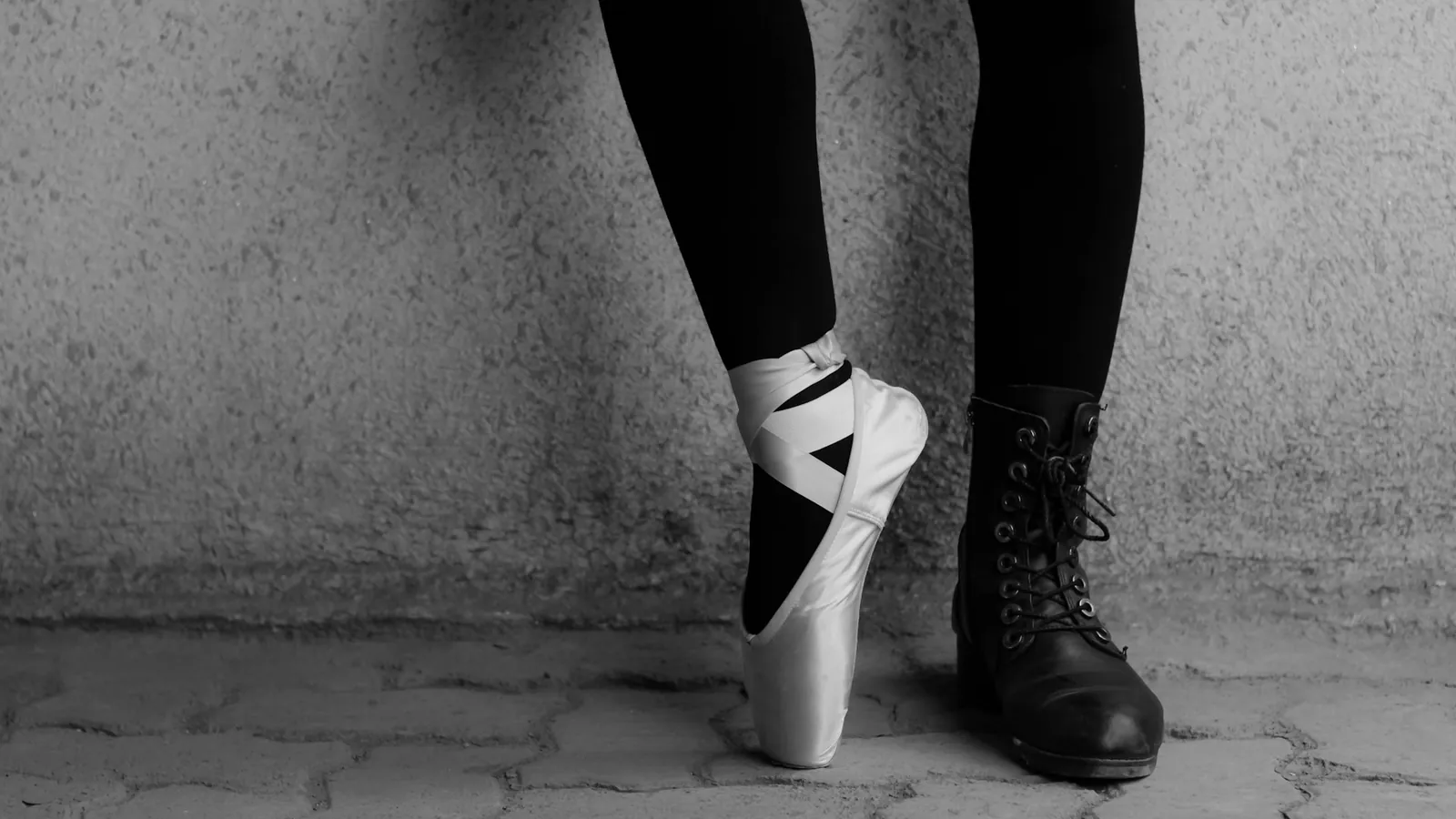
When watching a dance, you might follow the feet and miss what changes in the upper body. These are different questions when describing a variation. Manitoba’s dance curriculum accordingly distinguishes body actions, the parts involved, and where movement begins and ends. Applied to Zouk, this offers a way to look more closely: where does a movement start, and which parts participate? Location alone does not answer that. A person can remain in the same place while considerable movement happens within their body.
What footwork describes
One way to examine footwork is through movement directions. In their Zouk Atoms approach, Olga and Fernando organise the follower’s footwork into three-step patterns with regular timing. They distinguish forward, backward and sideways travel and explore transitions between patterns. This is their own system. It makes a concrete question understandable, however: what continuation emerges from the footwork currently being danced? A familiar pattern thereby acquires a structure that can be examined through the actual movement of the feet.
Moving a particular body part
An isolation directs attention towards an individual body part. Indiana’s education department dance glossary describes it as moving one body part at a time. The term therefore helps identify the region involved in a visible movement. It does not establish which muscles are working simultaneously. In the same glossary, articulation concerns clearly coordinating or differentiating body parts. This offers two possibilities when watching: following the part that stands out, or noticing how different parts work together.
This distinction also appears in Zouk teaching. Caroline Haugsted’s solo training separates footwork and turns from body and head movements. Her course addresses both dance roles and works with different directions and variations. This structure illustrates one possible approach: the footwork within a combination can be considered as one task, while the body movement presents another. It establishes no compulsory learning sequence. It initially explains why asking about the pattern alone can sometimes be too broad.
How a wave travels through the body
A body wave adds a sequence in time. Movement passes through different regions successively instead of happening everywhere at once. Dance researcher Claudia Fleischle-Braun describes such sequences in her study of Barbara Passow’s Jooss-Leeder teaching: waves can travel through the trunk and involve the arms or legs; movement can begin centrally or further out. This comes from another teaching context. The descriptive idea also helps when observing a Zouk wave: which region starts, and which follows? The sequence is part of what you recognise as a wave.
Direction can change too. Christina Montoya’s Zouk teaching distinguishes frontal and sideways body waves, among other forms, with different active contributions from the upper and lower body. Circular chest isolations are another element. She combines these body movements with familiar footwork, such as the basic or lateral. This explains why waves and footwork need to be considered together: different movement tasks occur within the same combination. Identifying which one is meant is more precise than a general instruction to dance the whole pattern differently.
Form and musical expression
A movement’s form does not fully determine its musical expression. Alex de Carvalho’s MAC curriculum addresses linear and circular chest and hip isolations alongside waves in different directions. It also includes the musical terms legato and staccato and the relationship to melody. This teaching approach examines movement form and musical interpretation together. Equating an isolation solely with a sharply accented movement would therefore be too restrictive. Its description also includes how connected or separated the individual movement moments appear.
British Columbia’s choreography curriculum likewise distinguishes body, space and time from movement dynamics. An action can change in size or timing without necessarily requiring a new pattern name. When watching a combination, you can deliberately follow just one of these properties. Does the pathway remain the same while the movement takes more time? Does a body movement become smaller while retaining its direction? These observations reveal possibilities within a variation whose underlying form is already familiar to you.