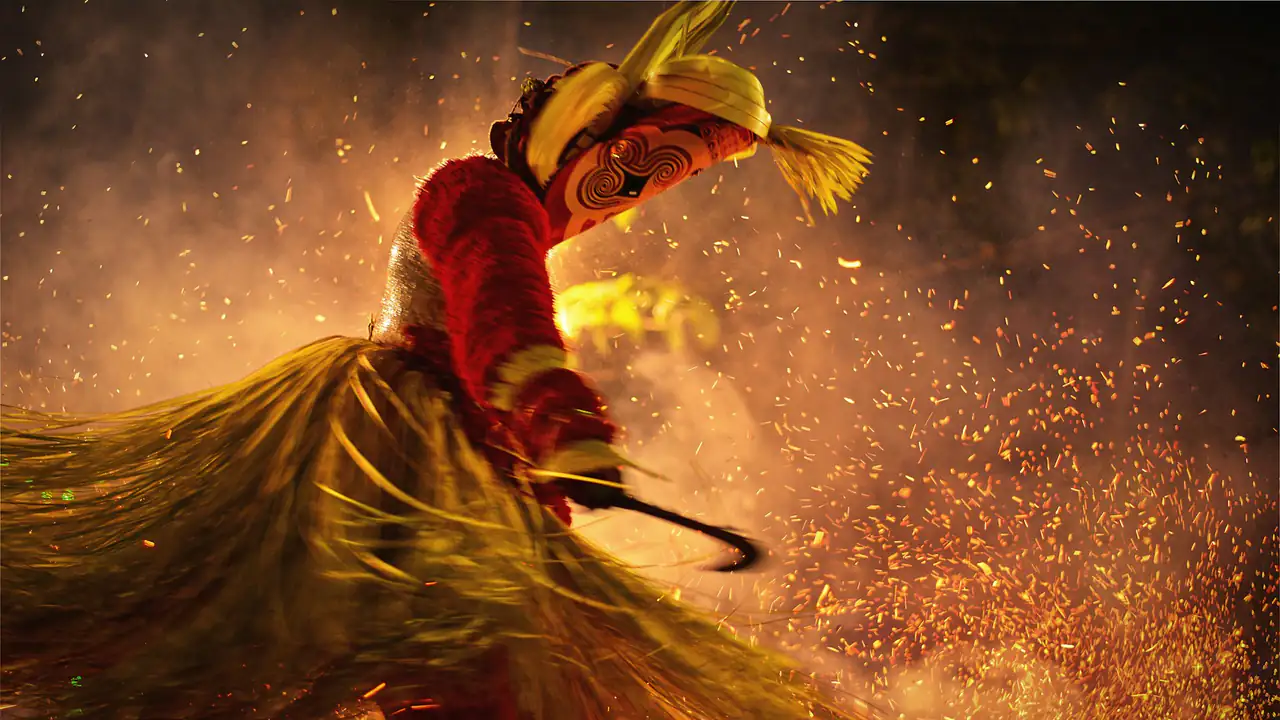
A group moves together. The meaning of that movement emerges from its occasion and from the participants’ understanding. Anthropologist Mariza Peirano suggests starting with their own distinctions: which actions do they consider special, and what order do they give them? This perspective leads to the people who pass on a practice, the responsibilities they hold and the stories they connect with it.
Marujada: A festival sustained by shared responsibilities
In Bragança, in the Brazilian state of Pará, Marujada belongs to the veneration of Saint Benedict. Dances, processions and responsibilities within a religious brotherhood are connected. A dossier produced by IPHAN and the Federal University of Pará describes the Roda: women use it to open the festive cycle on 18 December; the Capitoa and her deputy stand centrally, while experienced dancers organise the lines. These responsibilities give the movement its place in the occasion. The dances also appear outside devotional festivals. Understanding a performance therefore involves its occasion alongside its visible movement sequence.
Ester Paixão Corrêa’s fieldwork from 2015 to 2017 shows how far these responsibilities extend. Her interviewee Suely describes experienced Marujas who also help organise meetings and processions. Corrêa recounts collecting Dona Bia, the Capitoa at that time: participants gather at her home, eat breakfast and then proceed in ordered lines. The Capitoa holds her position throughout the year. Watching her dance therefore also means seeing someone whose responsibilities begin long before the public appearance. Her role connects the festive occasion with the continuing life of the community.
Semah: Understanding the movement as prayer
With Semah, finding the appropriate name already takes us into its religious context. The Alevi Community of Germany describes it as a ritual prayer within the Cem ceremony. Women and men turn together, accompanied by the bağlama, a long-necked lute. The community interprets the movement partly as a symbol of orbiting planets and movement in nature. Music, the body and religious meaning belong together in this account. Looking only at a turning movement reveals its shape; the practitioners’ explanation helps us understand why it forms part of their prayer.
Saadet Grandazzo, then chair of the Alevi cultural centre in Weil, emphasised this designation in a 2018 interview. Asked about Semah as a dance, she explicitly explained it as prayer. Describing a planned cross-border cultural festival, she said it would open with a Cem ceremony. People from Germany, France and Switzerland would also gather and exchange experiences. Her account placed religious practice alongside an invitation to meet. Getting to know such an event therefore involves listening, too: participants can explain what a movement means within their practice.
Ka Mate: Passing on your own story
With Ka Mate, its context also becomes accessible through those who preserve its story. Ngāti Toa Rangatira place this haka within the oral histories of Ngāti Toa and Ngāti Tūwharetoa. Their account concerns Te Rauparaha, who flees pursuers and finds shelter in a storage pit. He survives and emerges into the light. Ka Mate is connected here with a particular experience of danger, protection and survival. This inherited story offers an approach beyond looking at striking gestures alone: it names people and relationships to which the performance refers.
Te Papa museum documented one way of sharing this context in 2011. During the Rugby World Cup, Ngāti Toa presented an interactive audiovisual exhibition about Ka Mate there. Matiu Rei explained that they wanted to share their own story, from its creation through its later development. The community thus created an introduction for people with little previous knowledge of this oral history. Alongside public performance, there was space to learn about its background. The exhibition connected recognition of a familiar form with the people who tell its story and pass it on.