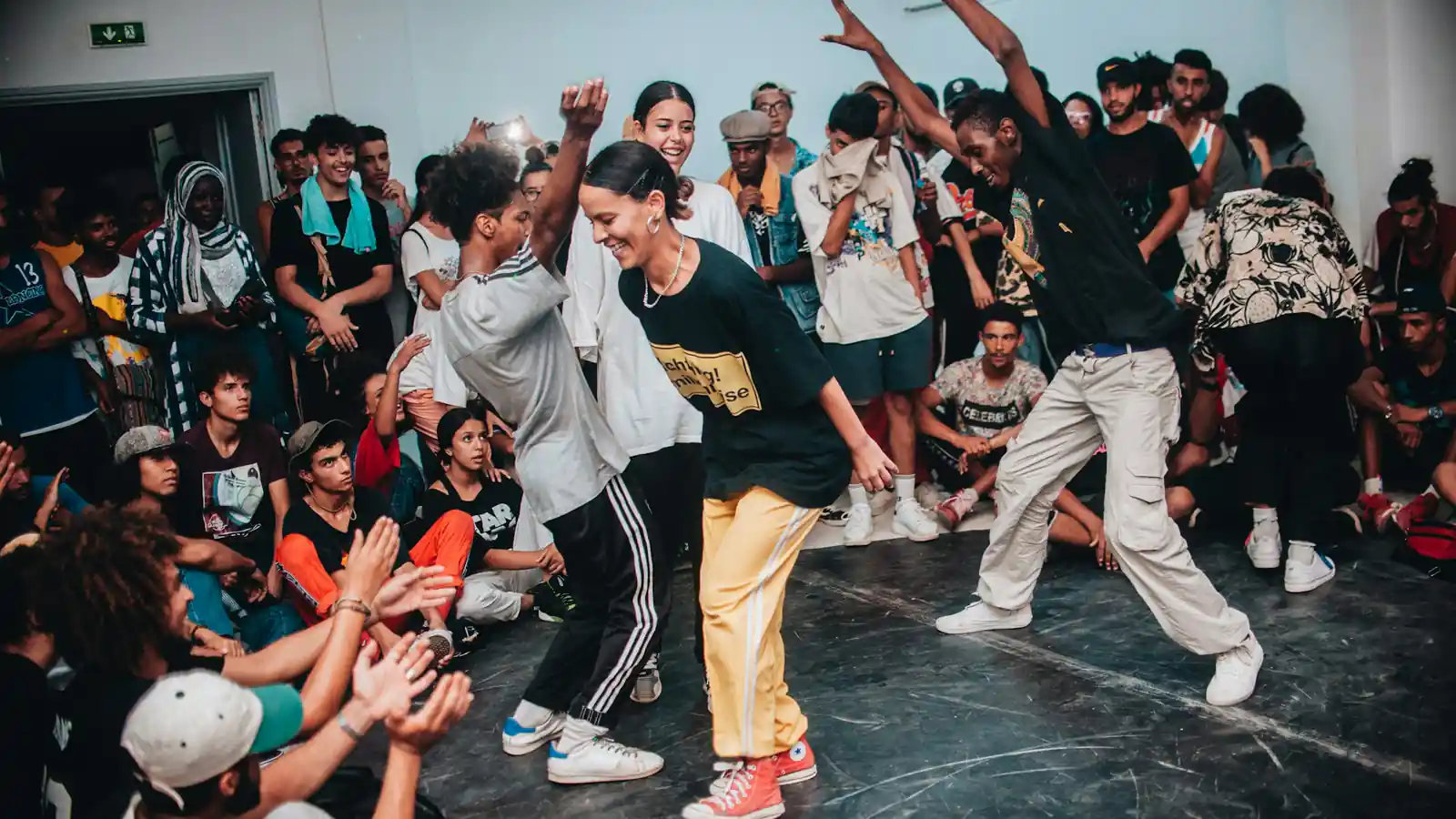
Two hours at a dance event rarely mean two hours of uninterrupted movement. A study of 18 adults attending Salsa events of their choice in London illustrates the difference. Within each two-hour observation, movement sensors classified an average of around 80 minutes as dancing. The remaining time also belonged to the evening but contributed differently to its physical demands. These recordings reveal something that duration alone conceals: describing the activity means accounting for how much dancing actually happens. This distribution describes the small group and events studied; it is not a fixed proportion for every social.
Several pathways supply energy together
Muscles need ATP, a substance whose breakdown directly releases energy for their work. Its small store is continually replenished during movement through interacting metabolic pathways. Phosphocreatine allows ATP to be restored rapidly. Glycolysis, the breakdown of sugar, also supplies ATP without directly requiring oxygen. Oxidative energy production contributes at the same time. Their relative contributions change during intense activity. There is consequently no instant at which the body switches completely from one system to the next. Even a short movement sequence is made possible by their combined activity.
In oxidative energy production, cells use oxygen to make energy from carbohydrates and fats available. The contribution of each fuel depends partly on the intensity and duration of movement. “Aerobic” describes this metabolic pathway; it does not automatically mean slow or effortless. Lactate, produced during carbohydrate metabolism, can also serve as fuel: other cells can take it up and oxidise it. These connections explain why dividing activity into entirely separate “endurance movements” and “fast movements” would be biologically crude. The body combines rapid energy supply with sustained provision within the same activity.
The distribution of pauses matters too
Two activity sequences can contain the same proportion of recovery yet impose different demands. Researchers tested this directly in six men performing knee extensions against a prescribed workload. The ratio of work to light active recovery remained constant while individual bouts became shorter or longer. Shorter alternations produced smaller fluctuations in certain muscle metabolic measures and oxygen uptake. Timing therefore changed the response to the same external power output. This distinction helps explain why the pattern of an evening matters; the laboratory intervals do not provide a break schedule for the dance floor.
On stage, this pattern forms part of the choreography. A video analysis of 93 professional dance performances compared classical ballet and contemporary dance. The ballet performances examined contained longer resting periods and more activity classified as very demanding. Contemporary performances included larger proportions of lighter to moderate activity. Researchers recorded visible movement using an observational framework, capturing changing demands rather than directly measuring muscle metabolism. A quiet section can follow a highly demanding passage within the same performance. Looking only at the overall impression of a piece can make its distribution of activity harder to recognise.
Dance form and execution belong together
Partner dancing also benefits from examining the actual task. In one study, 24 young adults danced four-minute bouts of waltz, foxtrot, swing and cha-cha, with a second swing bout and seated breaks between dances. A portable system measured oxygen uptake. At the prescribed tempos, swing and cha-cha produced higher average metabolic demands than waltz and foxtrot. Participants chose their combinations, while the dance order remained fixed. The finding therefore describes particular executions of these dances. It also illustrates why the broad label “partner dancing” requires further detail to describe physical demands precisely.
Freedom of movement also allows different intensities within one dance task. In a pilot study of 48 adults, participants danced alone without prescribed choreography, first moderately and later more vigorously. Oxygen uptake, heart rate and perceived exertion increased with the higher intensity instruction. Participants chose their movements and the music used. However, staff limited intensity at a specified heart-rate threshold, making this a guided free-form task. Its useful feature is the scope for adjustment: achieving greater physical exertion required neither learning a new dance form nor performing identical choreography.
What pulse and exertion each tell us
Heart rate counts heartbeats per minute. Its relationship with oxygen uptake during dance does not follow one conversion that fits everyone. A study of 19 professional modern dancers measured both during a dance class and treadmill exercise. They were associated at group level, but individual discrepancies were large. A displayed pulse therefore reports heart rate; a general formula does not turn it into an equally precise oxygen-uptake measurement. A number can reliably describe what was measured while offering only limited information about a different physiological question.
Oxygen uptake is determined through respiratory gas analysis and informs us about aerobic energy provision. Estimating the contribution without direct oxygen involvement requires further measurements and mathematical models. A 2025 methods review shows how these estimates depend on experimental design and assumptions. For example, measurements during lighter exercise can predict oxygen demand at higher power, which is then compared with actual uptake. This is a reasoned estimate with prerequisites. A chart showing precise “aerobic” and “anaerobic” percentages consequently contains more interpretation than a simple record of measured oxygen uptake.
How demanding dancing feels offers another perspective. Researchers compared an ordinary class, rueda de casino and a club condition in ten experienced Salsa couples. Although heart rate, expressed relative to resting and maximal values, was higher during rueda than during the ordinary class, reported exertion did not differ significantly between conditions. Pleasantness, assessed separately, was also similar. Pleasantness and effort are distinct questions, as are subjective assessment and cardiovascular response. A section someone enjoys can still feel physically demanding. Conversely, a section that feels easy does not reveal exactly how heart rate changed throughout it.
Endurance becomes apparent across longer periods
An immediate response says little about how endurance develops. That requires comparisons over time. Seventeen professionals from two contemporary companies completed a standardised dance test repeatedly. There were no clear changes after twelve weeks of rehearsal; following the subsequent eight-week performance period, heart rate and post-test lactate were lower. This was consistent with improved physical adaptation to the task. Without controlled group allocation, the observation cannot identify each activity’s contribution. It nevertheless illustrates why repeating the same task can reveal more about development than simply counting completed rehearsal hours.
Additional physical preparation has also been tested experimentally. Thirty-two modern dance students were allocated to their regular programme or supplementary aerobic and strength training. After twelve weeks, the supplementary group had improved more in maximal oxygen uptake and a repeated dance test. That test assessed a limited movement task, including spatial accuracy, rather than overall artistic performance. Aerobic and strength training were also combined. The study therefore demonstrates a possibility for additional preparation within this educational setting. Its design cannot isolate which particular training component caused the difference.
For personal endurance, the useful relationship is between capacity and the actual demand. The same physical task can require a different proportion of someone’s available capacity. A review of dance research therefore recommends considering movement, its timing and physiological responses together. Applied to a Brazilian Zouk evening, this provides a concrete way of looking: event duration becomes meaningful alongside dancing periods, interruptions and personal exertion. These describe different aspects of the same evening. Distinguishing them helps explain what feels manageable and where endurance is required, without using somebody else’s pulse as the benchmark.