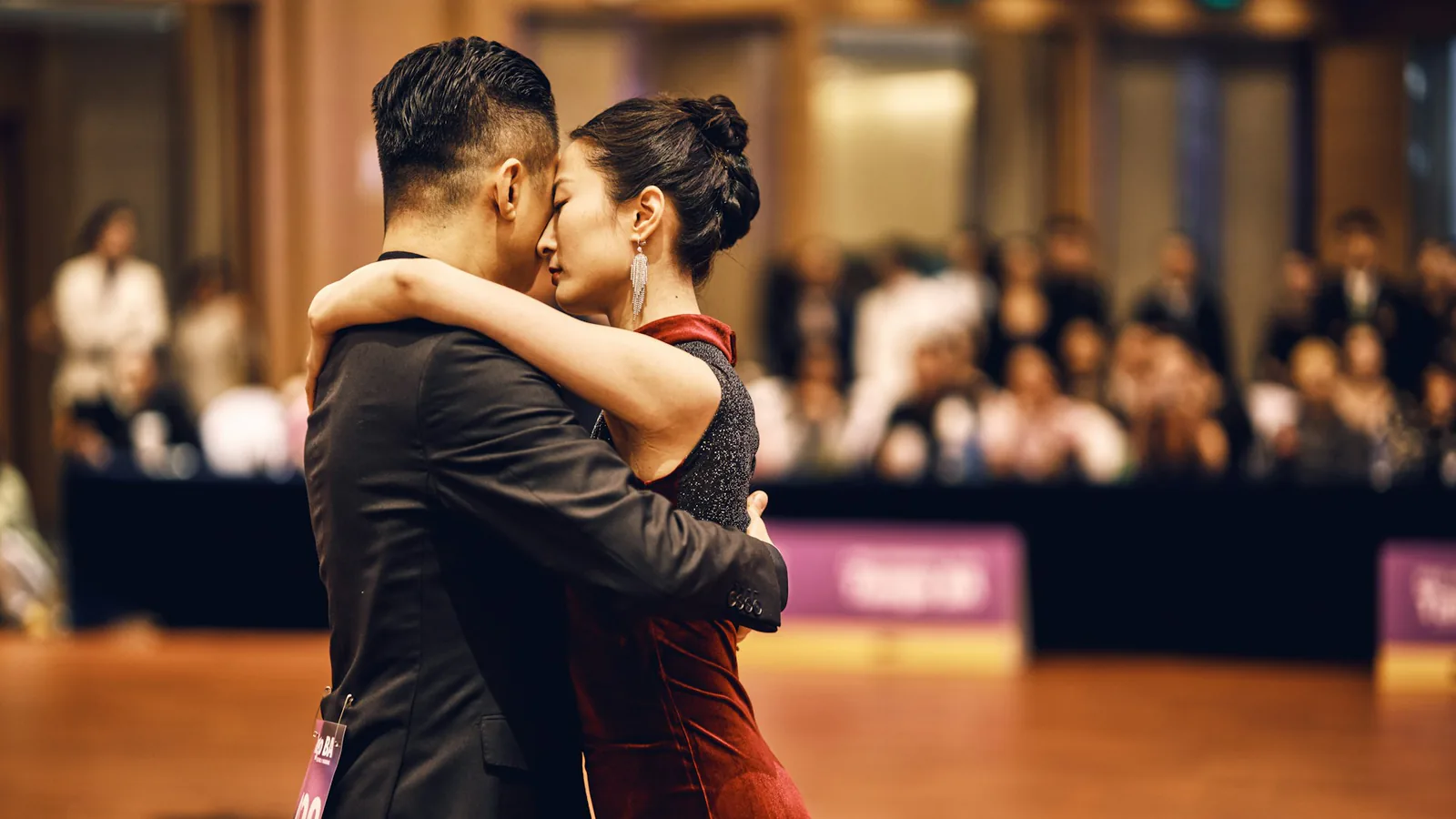
Argentine tango has roots on both sides of the Río de la Plata: in Buenos Aires and Montevideo. European immigrants, descendants of enslaved Africans and the region’s criollo population shaped this culture together. It encompasses music, dance and poetry. Seeing tango only as a particular way of holding a partner therefore overlooks much of what musicians, dancers and teachers pass on.
Movement begins with listening
In the classical orquesta típica, bandoneons and strings join piano and double bass. The music cannot be reduced to a uniform marking of time. Alongside the rhythmic accompaniment, a melody may sound sharply articulated or unfold in long, connected lines. Interpretation gives a familiar piece a different character.
This matters for dancing: responding to rhythmic emphasis is a different artistic choice from taking up a melodic line. The music offers several possibilities at once; its pulse alone does not describe everything there is to hear.
In improvised tango, the resulting movement is decided between the dancers. This does not mean having to invent unfamiliar figures every time. Drawing on fieldwork in Buenos Aires and European dance settings in 2017/18, Federica Banfi describes learned movement vocabulary combined with decisions in the moment. Familiar material remains available without determining the entire dance beforehand.
What the embrace leaves open
Nor does the distance between partners necessarily determine their whole dance. As early as 2003, tango teacher Gustavo Naveira challenged a rigid division between open and close embrace. From his teaching perspective, there are more possibilities in between, and changes in distance form part of how movement is constructed. The term abrazo, or embrace, should therefore not be confused with a single unchanging shape. A description such as “dancing close” reveals little by itself about how partners develop their movement together.
The other person's response becomes crucial. In Banfi's interviews, dancers describe how the same lead can be perceived differently and requires adjustment. Improvisation therefore also involves developing movement already under way. Offering something means being able to respond to what it becomes together.
One couple among other couples
At a milonga, meaning the dance event here, this includes sharing the floor. The ronda travels anticlockwise; couples adapt their space and progress to one another. This includes moments in place. Analía Centurión also describes how tandas group several pieces together and a cortina, a musical interlude, separates these groups. This creates opportunities to leave, rest or talk. Customs differ between places: this structure does not prescribe an identical sequence of events everywhere.
Tango continuing elsewhere is also part of its development. UNESCO describes a culture that its communities change and adapt to new environments.
The Orquesta Escuela Emilio Balcarce in Buenos Aires offers a concrete example of this transmission. Its artistic director Ignacio Varchausky explained in 2026 how young musicians explore historical orchestral styles through arrangements and collaboration with experienced colleagues. His aim is to provide foundations for their own musical decisions. The album presented for the orchestra’s 25th anniversary also includes new compositions. Historical knowledge is tested through playing: the written notes alone cannot convey everything that gives a recording its character.