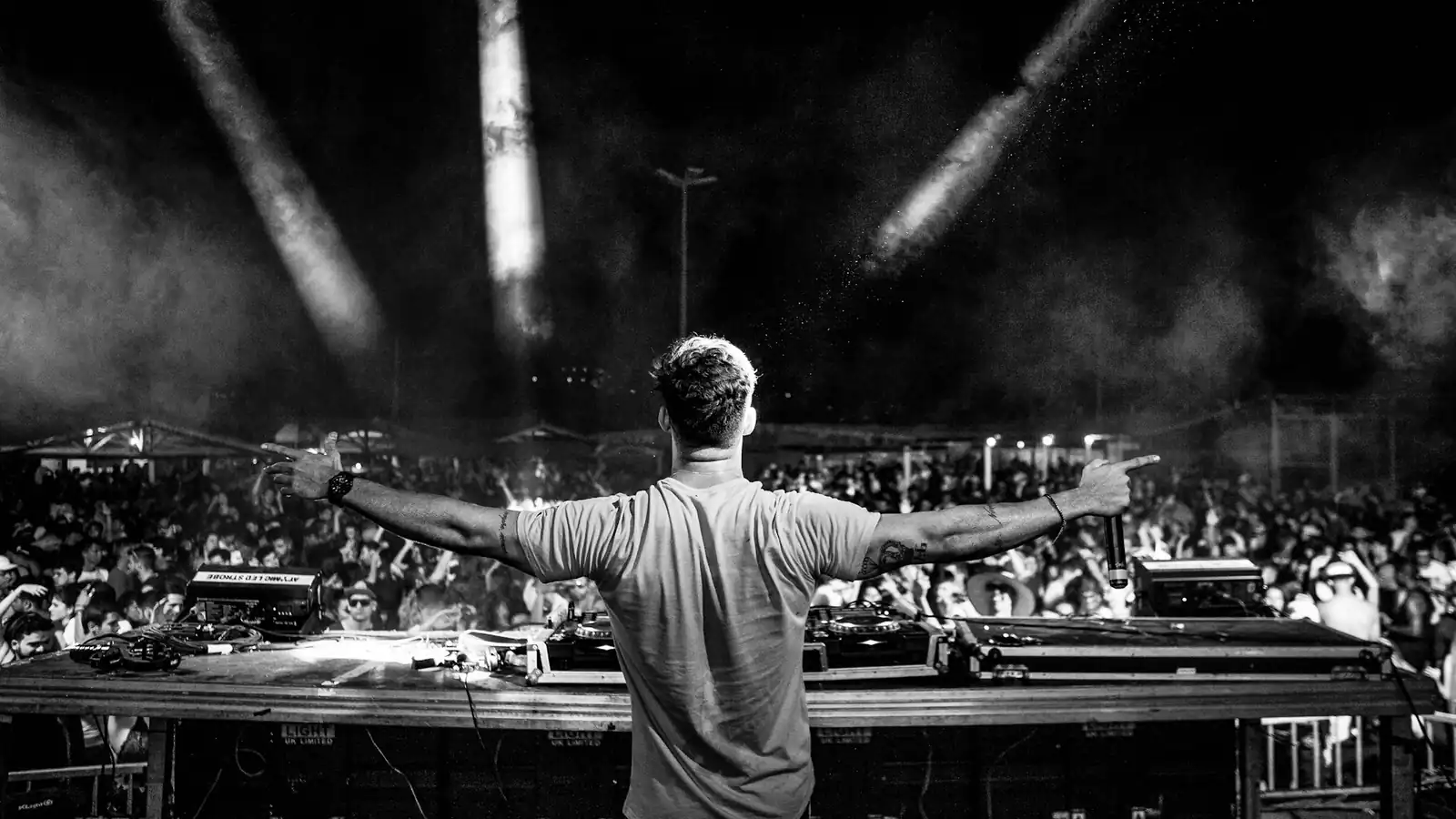
DJ Sprenk had prepared an opening set for a zouk weekender in Boston. Almost immediately, he abandoned it. In his published description, he explains that the planned energy curve did not suit the people who were there. This captures an essential part of DJing: having a selection ready and recognising when another direction might fit better. What goes into this work that, on the dance floor, we usually experience simply as the next song?
Selection begins long before the evening
Choosing spontaneously requires useful options. Speaking to Now Then magazine, Mr Scruff describes how much time he spends packing records. He selects different moods and tempos, bringing more approachable companions for unusual recordings. An awkward record travels with music that might help give it a place later. His collection therefore offers several potential continuations. Which one gets played depends on the evening as it unfolds. He also checks the equipment before the doors open, so that afterwards he can give his attention to the music.
With a digital collection, finding things becomes another part of the job. In an interview with Native Instruments, Luciano explains how he adds his own descriptions to tracks. His notes might identify music for an opening, a gradual build or a softer morning atmosphere. He finds these comments more useful than a simple star rating. A rating tells him little about what a particular recording might offer in the moment. These personal systems turn a large collection into a working resource: under time pressure, the DJ needs both to imagine a musical connection and to find the recording that could provide it.
Before her first bookings, swing DJ Sam Carroll even rehearsed the time pressure. At home, she assembled sequences in real time, choosing the next recording before the current song ended. She also tried out cables and software controls beforehand. Her musical ideas acquired a practical way of being put into action.
Being prepared and deciding in the moment
How much is settled beforehand varies. In a joint Tsugi interview with Amor Satyr, French DJ RONI describes their shared sets as improvised. Yet she prepares more extensively for particularly important dates, so she can be more present and connected with the audience while playing. Amor Satyr would like more time to rehearse individual transitions. Preparation and openness work together here: knowing a transition means less effort spent figuring out its execution when the moment arrives. What has been rehearsed is an option that might become useful during a set. The running order remains open.
Paying attention also means some distance from personal taste. Carroll describes how easily her own excitement can obscure what is happening elsewhere in the room. As a DJ, she wants to participate emotionally while also observing. She finds sustaining both kinds of attention demanding.
Her public account of a set at MLX9 in Melbourne in 2009 shows how ambiguous responses can be. Carroll describes a longer track that initially went down well, after which she felt the dancers were tired. In her view, the following selection also fitted poorly. The late hour, a parallel blues room and her own exhaustion entered her assessment too. For her, a full floor during one song therefore did not settle the quality of the whole sequence. Her account considers several possible connections and examines where her own choice had worked less well.
An evening has a wider context
Tango DJ Michael Lavocah approaches this task within a differently structured format: recordings are arranged in tandas, or groups of tracks. For him, the next selection depends on both the atmosphere and the direction he wants to develop. Several choices remain possible. He also describes how a longer evening changes as people arrive and leave. A tanda borrowed from another DJ will consequently work differently in another context. His approach looks beyond an individual track to the relationship between what has just played, the people in the room and what comes next.
Transitions also shape dancing together
How the music continues can have a very practical meaning in partner dance. In his 2017 Zoukology interview, DJ Dravid Shiv argues for continuous mixes. As a dancer, he finds fades between songs disruptive. He wants to make room for dances that continue beyond a single track. At the same time, he emphasises that partners may finish dancing together without waiting for the music to stop. His preference connects a musical choice with a social idea. The transition offers continuity; the two dancers still decide how long to stay together. It does not establish a rule for every zouk evening.
A song ending may also be precisely what a DJ wants to preserve. Speaking to MusicRadar, Mr Scruff explains that some recordings have powerful beginnings or endings of their own. He may leave room for these rather than automatically overlap them with the next track. His club approach considers how much shaping is already present in the recording. A restrained transition can keep that shape audible. This gives decisions at the mixer a concrete point of reference: what would an intervention add to the sequence, and which part of a recording might disappear in the process?
There is more work behind a set
An evening involving several DJs also requires coordination. Describing her work at Herräng Dance Camp in 2016, Carroll recounts regular meetings and changing assignments. The DJ managers fitted their schedules around bands, stage programmes and several dance floors. Changes required everyone involved to respond. DJs also exchanged thoughts about individual recordings. What dancers experience as a continuing programme consists, on this side, of handovers, knowledge of the event schedule and shared preparation. A personal selection has to fit into an evening to which other people are also contributing musically and organisationally.
Recurring nights give this work a longer horizon. In an interview with his venue, Band on the Wall, Mr Scruff describes his residency as an important setting for his creative development. Dependable conditions coexist with small changes from month to month. Going through his record collection also brought long-forgotten recordings back to his attention. A residency means playing regularly at the same venue, giving such rediscoveries a possible future home. The work continues while nobody is on the dance floor: getting to know a recording again, rediscovering an option and keeping it in mind for a coming evening.